Choosing when an invoice is due is one of the simplest ways to protect cash flow. Net 15, Net 30 and end-of-month (EOM) terms look similar on paper, but they change when money lands in your account. Put the term and a calendar due date on a free invoice generator so clients see both before the work starts.
This guide is a decision checklist for freelancers and small suppliers in the US, Canada, the UK, Ireland, Australia, New Zealand and Europe: what common terms mean, which clients suit which option, a worked cash-flow example, how to print terms plus an exact date, weekends, and when long B2B terms hit legal limits. It complements the free due-date calculator rather than replacing it.
Quick answer: default to Net 15 for new or late-paying clients, Net 30 for trusted ongoing work, and EOM or Net 30 EOM only when a buyer’s AP process requires it. Always print both the term (for example “Net 15”) and a calendar “Payment due” date. If rent or suppliers hit mid-month, Net 30 often means financing the client for a full month.
What Net 15, Net 30, EOM and due on receipt mean
Invoice payment terms tell the buyer how many days they have after the invoice date (or after month-end) before the balance is overdue. Conventions vary by market, but these labels are widely understood in English-speaking B2B work.
Due on receipt
Payment is expected as soon as the client receives the invoice. Use it for tiny one-off jobs, rush work or clients who already agreed to pay immediately. Still write a calendar date so “late” is unambiguous.
Net 7, Net 14 and Net 15
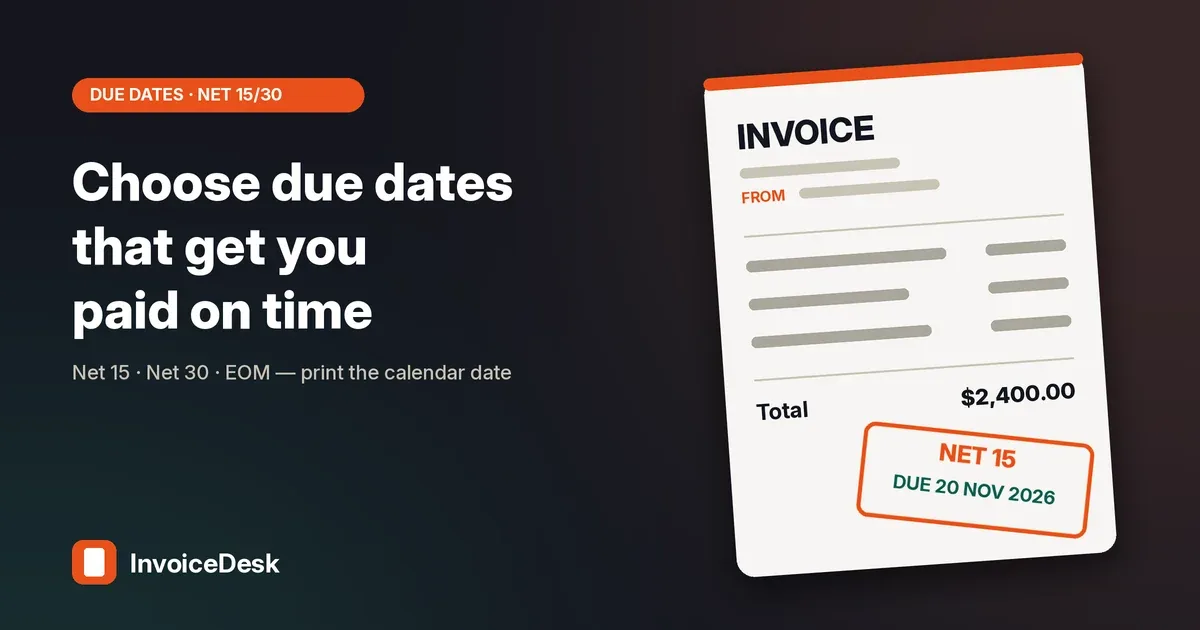
Net means “payment due this many days after the invoice date.” Net 15 is a common short cycle for freelancers: invoice on the 5th, due on the 20th. Net 7 and Net 14 suit weekly or fortnightly retainers, deposits that must clear before you start, or clients who previously paid slowly on Net 30.
Net 30, Net 45, Net 60 and Net 90
Net 30 is the default many US and Canadian small businesses expect. Larger buyers sometimes push Net 45 or Net 60. Net 90 is rare for freelancers and usually a red flag unless the fee funds the wait. Longer terms are not automatically illegal everywhere, but UK and EU rules put fairness limits on very long B2B dates (see below).
End of month (EOM) and Net 30 EOM
EOM sets the due date as the last day of the invoice month. An invoice dated 5 November is due 30 November under plain EOM. “EOM + 30” or “Net 30 EOM” usually means the last day of the invoice month plus 30 days — so a 5 November invoice is due 30 December. These terms suit AP teams that batch payments once a month; they often delay cash for freelancers who bill early in the month.
Custom days and business days
Some contracts use “10 business days” or a custom number of calendar days. Business-day counts skip weekends (and sometimes public holidays). When you use a custom count, still print the resulting calendar date so nobody has to recount.
How to pick terms by client type
Match the term to risk, relationship and the buyer’s process — not to what feels polite.
New clients
Start short. Net 15, or a deposit plus Net 15 on the balance, reduces how long you fund a stranger. For staged work, use deposits and milestone billing so you are not waiting on a single end-of-project Net 30.
Ongoing freelancers and retainers
Trusted monthly clients often sit on Net 15 or Net 30. Bill on a fixed day each month so their AP can predict you. If mid-month bills are tight, prefer Net 15 even with good payers.
Agencies, enterprises and public bodies
Large buyers may insist on Net 30, Net 45 or Net 60 and a purchase order. Negotiate what you can, or price the wait into the fee. In the UK, agreed dates with public authorities must usually be within 30 days; across the EU, public authorities generally pay within 30 days. Do not volunteer Net 60 to a public body when the law already expects faster payment.
Clients who pay late
Shorten the next invoice: move from Net 30 to Net 15, require a deposit, or pause new work. Pair shorter terms with the habits in how to get paid faster, and keep any late-fee wording aligned with your late fees and interest policy where your market allows it.
Worked example: $2,400 design invoice on 5 November 2026
Alex is a freelance designer. On Thursday 5 November 2026 Alex invoices a marketing client $2,400. Common terms land as follows:
- Net 15 → due Friday 20 November 2026
- Net 30 → due Saturday 5 December 2026. With Move to next Monday → Monday 7 December 2026; with Move back to Friday → Friday 4 December 2026
- End of month (EOM) → due Monday 30 November 2026 (already a weekday)
- EOM + 30 (Net 30 EOM) → due Wednesday 30 December 2026
Cash-flow if Alex’s rent and software hit around the 15th:
- Net 15 aims for payment by 20 November — often close enough for mid-month costs.
- Net 30 pushes expected cash into early December, so Alex finances the client for about a month.
- Plain EOM (30 November) sits between Net 15 and weekday-adjusted Net 30.
- Net 30 EOM pushes cash to 30 December — almost two months after the invoice.
Practical pick for a new client: 40–50% deposit on kickoff, balance on Net 15. For a trusted retainer, Net 15 or Net 30 billed on the same day each month is usually enough. Avoid Net 30 EOM unless AP truly requires it and you have priced the wait.
How to put terms and an exact due date on the invoice
Buyers pay faster when the invoice shows both the rule and the calendar date. “Net 30” alone forces AP to calculate; a missing due date makes “late” arguable.
Step 1 — Decide the term before you bill
Agree Net 15, Net 30, EOM or another option in the proposal or contract. Note buyer rules (PO required, EOM batching, invoice cut-off dates).
Step 2 — Turn the term into a calendar date
Open the free invoice due date calculator. Set Invoice date to the day on the invoice (for Alex, 5 November 2026). Choose Payment terms — for example Net 15, Net 30, End of month (EOM) or EOM + 30 (Net 30 EOM). Under If the due date is a weekend, pick Keep the date, Move to next Monday or Move back to Friday. Read the result labelled Payment due.
Step 3 — Print both term and date on the invoice
In the InvoiceDesk generator, create a document with title Invoice. Under Payment details, set the same payment terms you calculated. Put the calendar due date where the client will see it — for example “Payment due by 20 November 2026 (Net 15)” in the terms or notes. Before you send, use the checklist reminder for Invoice date and payment due date. US-style defaults may mention a past-due late fee; keep that line aligned with your contract.
Step 4 — Send on time
An accurate due date only helps if the invoice leaves when the invoice date says. Attach any PO or timesheet the buyer needs, and bill recurring work on a fixed weekday.
Weekends and holidays
Net counts are usually calendar days, so a due date can fall on a weekend. Decide the rule up front:
- Keep the date — still due that calendar day; payment may clear the next banking day.
- Move to next Monday — common when you want a working-day due date.
- Move back to Friday — useful if you want funds before the weekend.
Unless the contract defines “business days” including public holidays, state the rule in your terms and recalculate so the printed date matches.
When long terms hit legal limits (UK and EU)
US practice often treats Net 30 as a commercial convention rather than a single federal statute — do not invent state-by-state rules. Focus on clear contracts and cash-flow pricing.
In the UK, GOV.UK late commercial payments guidance (checked live 5 November 2026) says an agreed payment date must usually be within 30 days for public authorities or 60 days for business transactions. Longer than 60 days for B2B is allowed only if it is fair to both businesses. If no date was agreed, payment is late 30 days after the customer gets the invoice, or 30 days after delivery if that is later.
The European Commission’s late payment page (Directive 2011/7/EU, checked live 5 November 2026) summarises similar EU rules: public authorities generally pay within 30 days (60 only in exceptional cases); enterprises pay within 60 days unless they expressly agree otherwise and it is not grossly unfair.
Practical takeaway: do not accept open-ended “pay when we get paid” language, and treat Net 90-style requests as a negotiation — shorten the term, raise the fee or take a deposit. Choosing a sane due date up front beats relying on interest after the fact.
FAQ
Is Net 30 always the “standard” term?
It is common in US and Canadian B2B work, but it is not mandatory. Freelancers can use Net 15, due on receipt or deposits. Enterprise buyers may demand longer; that is a commercial negotiation.
Should I print Net 15 or the calendar date?
Print both. “Net 15” explains the rule; “Payment due by 20 November 2026” removes maths for AP and makes chasing clearer.
What if the client’s AP only pays once a month?
Ask for that in writing, then set your invoice date and terms so the due date lands on or just before their run. EOM can fit that process — but price the extra wait or take a deposit.
Do weekends extend the due date automatically?
Only if you and the client agree. Use the calculator’s weekend options and put the chosen calendar date on the invoice.
Can I switch a slow payer from Net 30 to Net 15?
Yes for future invoices. State the new terms on the next quote and invoice. You generally cannot shorten an already issued due date without agreement.
Is EOM the same as Net 30?
No. On a 5 November 2026 invoice, EOM is 30 November; Net 30 is 5 December (a Saturday).
What about Net 30 EOM?
That usually means end of the invoice month plus 30 days (30 December in this example). It is much slower than Net 30 — use it only when AP requires it.
When should I add late fees or interest?
After the due date has clearly passed, and only in line with your contract and local rules. Clear due dates make any later claim easier to explain.
Related tools
- Payment terms guide — plain-English Net, EOM and due-on-receipt wording for invoices
- Freelancer invoice template — ready layout with space for terms and due date
- How to charge late payment interest on a UK business invoice — what to do after a UK B2B due date is missed
This article is general information for freelancers and small suppliers, not tax, accounting or legal advice. Confirm payment-term rules, late-payment rights and contract wording for your country (and any buyer-specific procurement rules) before you rely on them.