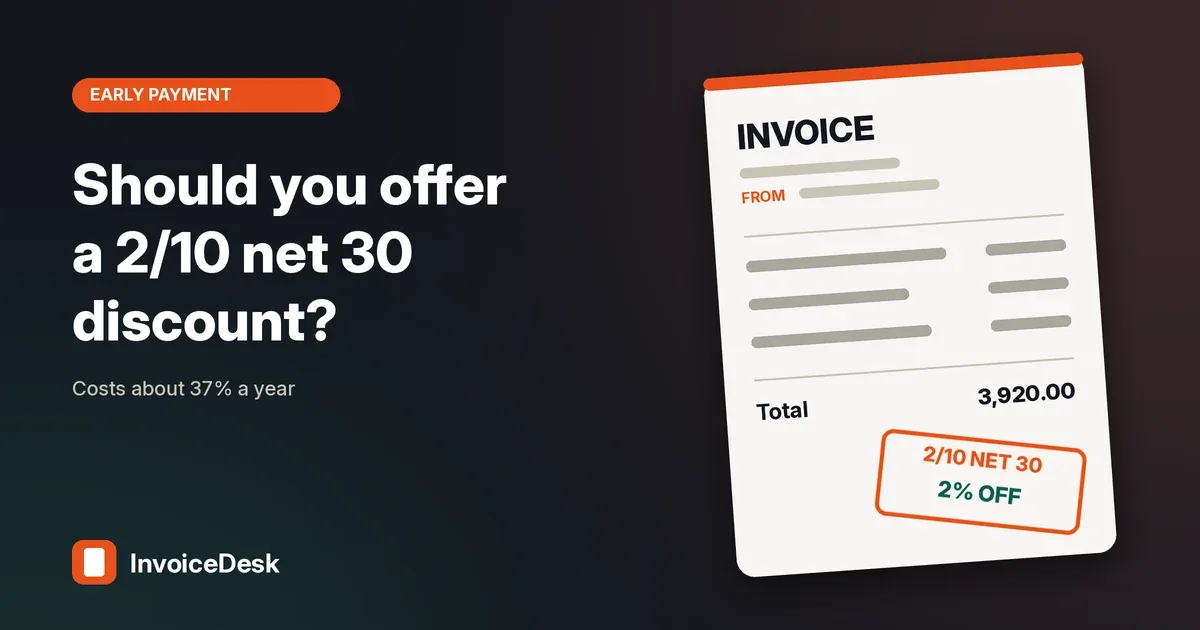
An early payment discount is a small price cut you offer a client for paying an invoice sooner than the due date. The most common wording is "2/10 net 30": take 2% off if the invoice is paid within 10 days, otherwise pay the full amount within 30 days. It can speed up cash flow, but it is more expensive than it looks, so run the numbers before you add it to your terms.
This guide explains how to read 2/10 net 30, shows a worked example with the true annual cost, covers when the discount is worth offering, and shows how to write it on an invoice so there is no argument later. You can test your own figures in the free invoice discount calculator.
Quick answer: with 2/10 net 30, a client who pays on day 10 instead of day 30 saves 2%. For you, that is giving up about 2.04% of the money you actually receive to get it 20 days sooner, which works out to roughly 37% a year. It is worth it only if slow or late payment is costing you more than that, for example overdraft interest, missed supplier discounts or real cash-flow stress.
What "2/10 net 30" means
Payment terms like this have three numbers:
- 2 is the discount percentage.
- 10 is the number of days the client has to pay and still get the discount.
- 30 is the number of days until the full invoice amount is due.
So "2/10 net 30" reads as: 2% discount if paid within 10 days, otherwise the net amount is due within 30 days. Other versions you will see are 1/10 net 30, 2/15 net 45 and 3/7 net 30. The days are counted from the invoice date unless your terms say otherwise. For a refresher on plain net terms, see our guide to payment terms, and use the invoice due date calculator to turn Net 30 into a calendar date.
Worked example: a 4,000 invoice
A web developer invoices a business client 4,000 (in your own currency, before any tax) with terms of 2/10 net 30. For simplicity, the numbers below ignore tax.
If the client pays within 10 days
- Discount: 4,000 × 2% = 80
- Amount paid: 4,000 − 80 = 3,920
- Money arrives on day 10 instead of day 30, so you receive it 20 days sooner.
If the client pays on day 30
- Amount paid: the full 4,000.
What the discount really costs
To get 3,920 twenty days earlier, you give up 80. The cost of that "loan" is:
- Cost for the period: 80 ÷ 3,920 = 2.04%
- There are about 18.25 periods of 20 days in a year (365 ÷ 20).
- Simple annual cost: 2.04% × 18.25 = about 37.2%
- Compounded annual cost: about 44.6%
That is a high price compared with most overdrafts or short-term credit. It is the reason the offer only makes sense when cash is genuinely tight or when clients routinely pay far beyond day 30.
How terms change the cost
Using the same simple method (discount ÷ amount paid, scaled to a year):
- 1/10 net 30 costs about 18.4% a year.
- 2/10 net 30 costs about 37.2% a year.
- 3/10 net 30 costs about 56.4% a year.
- 2/10 net 60 costs about 14.9% a year, because the client is moving payment 50 days earlier rather than 20.
The longer the gap between the discount date and the net date, the cheaper the discount is for you. If you already allow 60 days, a 2% early discount is much easier to justify than on 30-day terms.
When an early payment discount is worth it
It can make sense when:
- You regularly wait 45 to 90 days to be paid and your cash flow suffers.
- You pay your own suppliers or contractors quickly and need the money in.
- You borrow to cover gaps and the interest costs more than the discount saves.
- You work with larger clients that already process early-payment offers and will actually use them.
It usually does not make sense when:
- Your margin is thin. A 2% discount on a job with a 15% margin takes about a seventh of your profit.
- Most clients pay on time anyway. You would give away money for nothing.
- Clients take the discount but still pay late, which is a common problem. Decide in advance how you will handle it.
- You have a small number of clients and a firm invoice-chasing routine that already works.
Alternatives that cost less: ask for a deposit or milestone payments (see our guide to deposits and milestone billing), shorten your terms to Net 14, or use clearer reminders. Our guide on how to get paid faster covers these options.
How to write it on an invoice
Clients take discounts they can see clearly. Put the terms in two places so there is no confusion:
- In the payment terms field: "2% discount if paid within 10 days of invoice date. Full amount due within 30 days."
- In the notes: show the discounted amount and the date it applies until, for example "Pay 3,920.00 by 16 November 2026 to take the early payment discount."
If you create your invoice in the InvoiceDesk invoice generator, use the Payment terms and Notes fields for this wording, and set the due date to the full net date. Do not subtract the discount from the invoice total up front unless the client has already agreed to it, because many clients will not pay on time and you would lose the discount for nothing.
Tax and the discount
Tax treatment depends on the country and on how the discount is agreed, so check your local rules before you rely on a rule of thumb. As a general principle, VAT, GST and sales tax are worked out on the price after a discount given at the time of sale. For a conditional prompt payment discount, such as 2/10 net 30, many tax authorities expect the tax to reflect what the customer actually pays, and the terms should be clearly stated on the invoice. Always confirm the treatment with your tax authority's guidance or an accountant for your country, and keep the discount terms in writing.
If a client takes the discount after you have issued the invoice, do not edit the original document. Issue a credit note for the discount amount instead. See credit notes explained and use the credit note generator to create one.
What to do when clients short-pay or pay late
Two problems come up often with discount terms:
- The client pays late but still deducts the discount. Reply politely with the invoice terms and the date payment was due for the discount. Ask them to pay the difference. Your written terms are what make this a simple request.
- The client pays in full on day 10. If they paid the full 4,000 early, they overpaid under your terms. Either refund the 80 or credit it against the next invoice, depending on what you agreed.
Set a rule for yourself in advance: the discount applies only if the payment arrives in your account by the discount date, not when the client approves it.
Frequently asked questions
What does 2/10 net 30 mean?
It means a 2% discount if the invoice is paid within 10 days; otherwise the full amount is due within 30 days.
Is a 2% early payment discount worth it?
On 30-day terms it costs roughly 37% a year, so it is expensive money. It can still be worth it if late payment costs you more through borrowing costs or lost opportunities.
Should I offer an early payment discount to every client?
Not necessarily. Many freelancers offer it only to clients who tend to pay slowly or to larger accounts where the cash-flow benefit is meaningful. You can also write it into a specific contract rather than your standard terms.
Is VAT or sales tax charged before or after the discount?
Tax on an ordinary discount is charged on the discounted price. For a conditional early payment discount, rules vary by country, so state the terms on the invoice and check your local tax guidance.
Can I offer the discount after I have sent the invoice?
Yes, but issue a credit note for the discount amount rather than editing the original invoice.
What are good alternatives to an early payment discount?
Shorter payment terms such as Net 14, deposits and milestone billing, automatic reminders, and clear late payment terms. Our late fees and interest guide explains how to add a late fee as the other side of the same coin.
Next steps
Try your own numbers in the invoice discount calculator, then add your chosen terms to a new invoice with the free invoice generator. If you are not sure a discount suits your business, start with a smaller offer such as 1/10 net 30 and see whether clients actually use it.
This article is general information, not tax or legal advice.