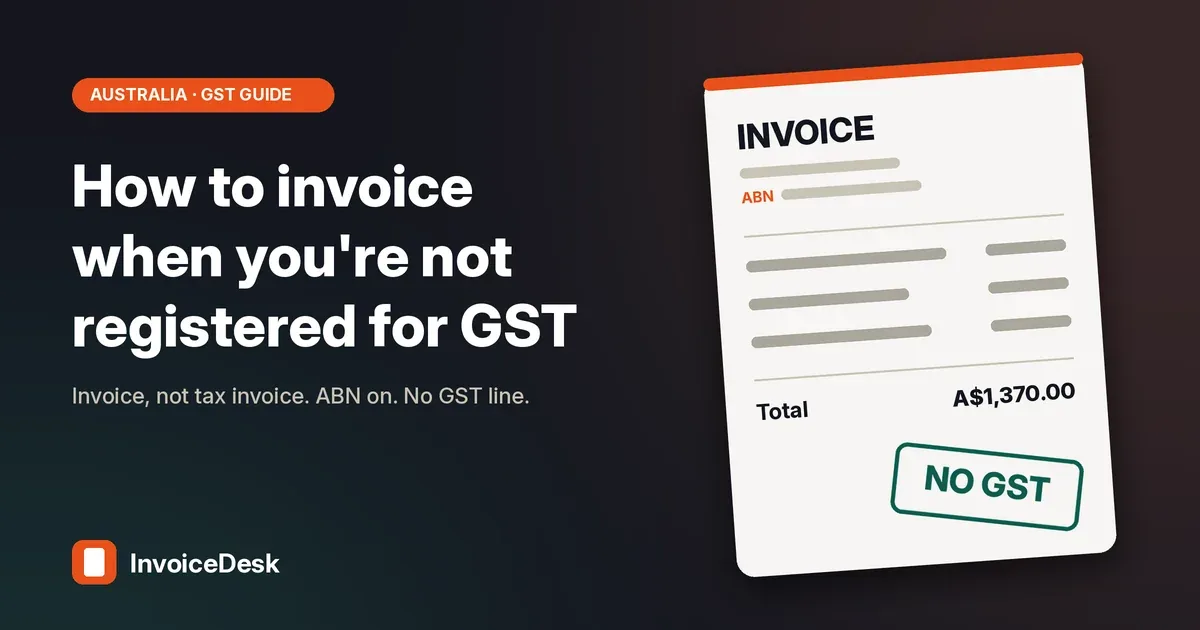
If you run a small business or work as a sole trader in Australia and you are not registered for GST, you still need to get paid, and that usually means sending an invoice. The rules are simpler than for GST-registered businesses, but a few details matter: what you call the document, whether your ABN is on it, and what you must leave off. This guide walks through each one, with a worked example you can copy.
Quick answer: send an ordinary invoice headed "Invoice" (never "Tax invoice"), show your ABN, charge no GST, and add a short note that you are not registered for GST.
Do you need to register for GST?
Before you invoice without GST, make sure you are allowed to. According to the ATO's Registering for GST page, you must register when:
- your GST turnover is A$75,000 or more (A$150,000 or more for non-profit organisations)
- you start a new business and expect turnover to reach the threshold in the first year
- you provide taxi, limousine or ride-sourcing travel, whatever your turnover
- you earn income through the sharing economy or digital platforms covered by the ATO's sharing economy rules
- you want to claim fuel tax credits.
GST turnover is your total business income, not your profit, minus items such as the GST included in your sales and input-taxed sales. You reach the threshold if your turnover for the current month plus the previous 11 months is A$75,000 or more, or if your projected turnover for the current month plus the next 11 months is likely to be.
If none of these apply, registration is optional. The ATO says to check your turnover every month and to register within 21 days once you are required to. If you should have registered and did not, you may have to pay GST on sales made since the date you were required to register, even if you did not include GST in your prices, plus penalties and interest. Our guide to the GST registration threshold in Australia explains the calculation in more detail.
Invoice or tax invoice: what's the difference?
Australia has two main kinds of invoice, as business.gov.au explains:
- Tax invoice: used by GST-registered businesses. It shows the GST on the sale and lets a GST-registered buyer claim a GST credit.
- Regular invoice: used by businesses that are not registered for GST. It does not show any tax.
The ATO is clear on the naming. On its Setting up your business invoices page it says that if you are not registered for GST, your invoices should not include the words "tax invoice". You issue standard invoices instead.
There is also no GST for you to add. The ATO's page on when you can't claim a GST credit describes suppliers that are not registered or required to be registered for GST as unable to charge GST, and their customers cannot claim GST credits on those purchases.
What to put on an invoice when you're not registered for GST
No law sets out the exact contents of a regular invoice. Business.gov.au lists what is common practice:
- The word "Invoice" as the heading (you must not use "tax invoice")
- Your business name
- Your ABN
- A unique invoice number
- The date you issued the invoice
- Your contact details (postal address, email, phone)
- A description of the goods or services, with quantity and price
- When and how you want to be paid
- The buyer's name or business name.
Two extra lines save a lot of back-and-forth:
- A GST statement, for example: "No GST has been charged. [Your business name] is not registered for GST." This is not a legal requirement, but it answers the question before your client's bookkeeper asks.
- Clear payment terms, such as "Payment due within 14 days" plus your BSB and account number or a payment link.
What to leave off: no GST line, no "10% GST", no "price includes GST" and no "plus GST". Every amount is simply the price.
Why your ABN matters even without GST
Being registered for GST and having an ABN are two different things. You can hold an ABN without being registered for GST, and you should still quote it on your invoices.
If you supply a business and do not quote an ABN, the payer generally has to withhold tax at the top rate from the payment when the total payment for the supply is more than A$75 (excluding GST), according to the ATO's withholding if ABN is not provided page. The ATO's Statement by a supplier page puts that rate at 47% (from 1 July 2017). Putting your ABN on the invoice is one of the ways to avoid it. See Do I need an ABN to invoice? for when you need one and how to apply.
Selling to consumers: receipts and itemised bills
If your customers are members of the public, the Australian Consumer Law also applies. The ACCC says businesses must give consumers a receipt for anything that costs over $75, and for smaller amounts if asked (within 7 days). The receipt must show your business name, your ABN or ACN, the product or service, the date it was supplied and the price. If a consumer asks for an itemised bill for a service, you must provide one within 7 days, showing how the price was worked out, plus labour hours and hourly rate and materials where relevant.
A clear invoice marked "Paid" or a separate receipt covers this. The free receipt generator makes one in a minute.
Worked example: a no-GST invoice
Mia is a freelance graphic designer in Brisbane. She trades as a sole trader under her own name, has an ABN, and her GST turnover is well under A$75,000, so she has chosen not to register for GST. She has designed a logo and a set of business cards for a local café, which is a business client.
Her invoice looks like this:
INVOICE                                   Invoice no: 2026-014
Mia Chen Design                           Date: 2 November 2026
ABN 12 345 678 901 (example only)         Due: 16 November 2026
mia@example.com · 0400 000 000

Bill to: Bean There Café, 1 Example St, Brisbane QLD 4000

Description                         Qty   Price       Amount
Logo design (3 concepts, 2 rounds)  1     A$1,200.00  A$1,200.00
Business card design (hours)        2     A$85.00     A$170.00

TOTAL DUE                                             A$1,370.00

No GST has been charged. Mia Chen Design is not registered for GST.
Payment: bank transfer to BSB 000-000, account 00000000 (example)
Reference: 2026-014
Notice what Mia did:
- The heading says Invoice, not "Tax invoice".
- Her ABN is shown, so the café has no reason to withhold 47% from the A$1,370.
- There is no GST line and the total is the same as the sum of the items.
- The GST note answers the obvious question in one sentence.
- The invoice number follows a simple yearly sequence, so no number is ever reused.
- The due date and payment details are right there, so the café can pay without emailing her.
If Mia registers for GST later, from her registration date her invoices change: she adds 10% GST to taxable sales, heads the document "Tax invoice" and lodges a BAS.
How to make a no-GST invoice in InvoiceDesk
The Australian invoice generator opens as a tax invoice by default. To make a no-GST invoice:
- Open the generator. Under GST treatment preset, choose Not registered for GST – no GST. That sets GST to zero.
- Under Rename labels, change the document title from "Tax Invoice" to "Invoice" (the preset reminds you of this).
- Enter your business name, ABN and contact details.
- Add your client, the invoice number, the date and the due date.
- Add each item with a quantity and price.
- Type your GST note and payment details in the notes field.
- Download the PDF or print it. Everything runs in your browser, with no sign-up.
Keep a copy of every invoice. Business.gov.au says you need to keep most business records for at least 5 years.
Common mistakes to avoid
- Charging GST when you're not registered. You can't charge GST, and your client can't claim it back.
- Calling the document a "tax invoice". The ATO says not to.
- Leaving off your ABN. It can cost you 47% of a business client's payment until it's sorted out.
- Not watching your turnover. Check it monthly against the A$75,000 threshold, both the past 12 months and the next 12.
- Reusing invoice numbers. Every invoice needs its own unique number.
FAQ
Can I charge GST if I'm not registered?
No. Only GST-registered businesses can charge GST. If you add GST to an invoice while unregistered, your client can't claim a GST credit for it.
My client asked for a tax invoice. What should I send?
A regular invoice with your ABN and a note that you are not registered for GST. A tax invoice exists so a buyer can claim GST credits, and there is no GST to claim on a purchase from an unregistered supplier. Your client can confirm your status on ABN Lookup, which shows whether an ABN is registered for GST.
Do I have to send an invoice at all if I'm not registered for GST?
Business.gov.au says businesses that aren't registered for GST don't need to give regular invoices, but it is good practice. You must still give consumers a receipt for sales over $75 or when they ask for one.
Should I write "GST: $0.00" on my invoice?
It's clearer to leave the GST line off completely and add a one-line note that you are not registered for GST. A "$0.00 GST" line can make the document look like a tax invoice.
Can I register for GST voluntarily?
Yes. If you don't meet any of the compulsory tests, registration is optional. The ATO says that if you choose to register, you generally must stay registered for at least 12 months, charge GST on taxable sales and lodge BAS.
What changes on the day I become registered?
From your GST registration date, you charge 10% GST on taxable sales, issue tax invoices (for taxable sales over A$82.50 including GST, or when a customer asks) and lodge business activity statements. The GST calculator helps you add or remove the 10%.
This article is general information, not tax advice. Rules and figures can change. Check the linked ATO and business.gov.au pages, or speak to a registered tax agent, for your own situation. Sources checked 2 November 2026.