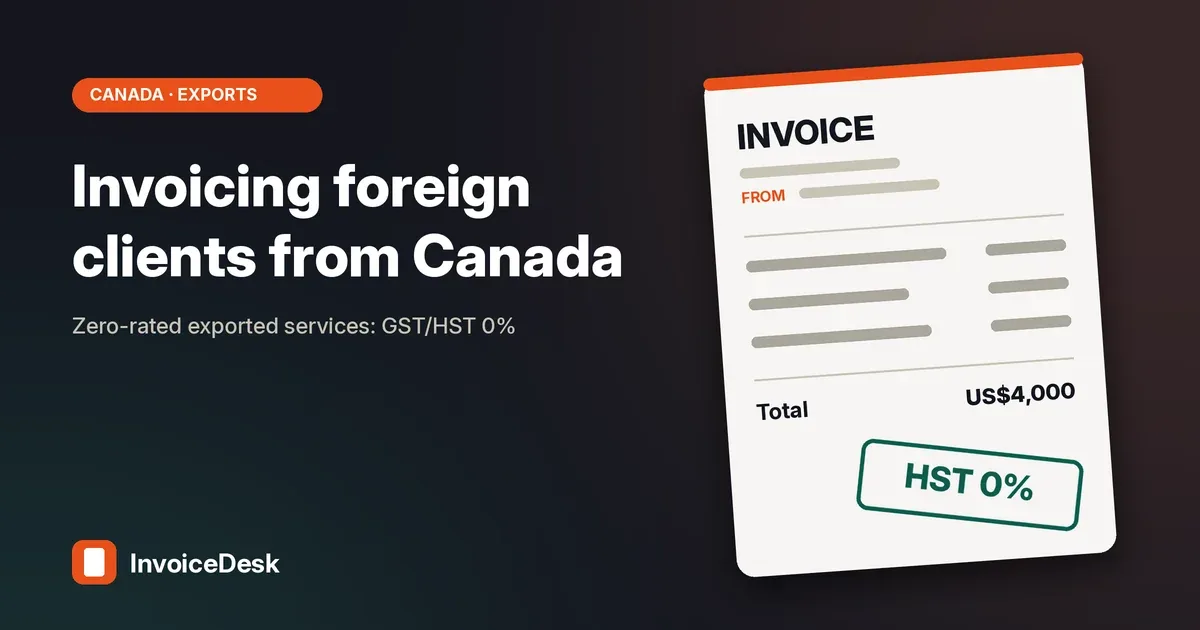
If you live in Canada and your client is a company in the US, UK or Europe, the invoice usually looks almost the same as a domestic one, with one big difference: many services you supply to a non-resident business are zero-rated, so the GST/HST line reads 0% instead of 5%, 13% or 15%. You can build that invoice in the free Canada invoice generator, set the currency to USD, EUR or GBP, and show the tax line at 0%.
This guide explains what zero-rated means for exported services, who qualifies, the common exceptions that catch people out, how to convert a foreign-currency invoice to Canadian dollars for your return, and a full worked example for an Ontario web developer billing a US client.
Quick answer: if you are a GST/HST registrant and you supply a service to a non-resident business that is not in Canada while dealing with you, the supply is often zero-rated under Part V of Schedule VI to the Excise Tax Act. You charge 0% GST/HST, still report the sale, keep evidence that the client is a non-resident, and can still claim input tax credits on related business costs. If the service is done to property in Canada or delivered to people while they are in Canada, the answer often changes.
Zero-rated is not the same as "no GST/HST"
Canada has three different situations that all end with no tax on the invoice, and mixing them up leads to wrong invoices and wrong returns.
Not registered (small supplier)
If your worldwide taxable sales stay at or under $30,000 over four consecutive calendar quarters, you are usually a small supplier and don't have to register. You don't charge GST/HST on anything. We cover that case in invoicing as a Canadian small supplier without GST/HST. Note that the CRA counts zero-rated supplies, including sales to foreign clients, toward that $30,000 test.
Exempt
Exempt supplies, such as many financial and health services, are outside the GST/HST. You don't charge tax and you generally can't claim input tax credits on the costs of making them.
Zero-rated
A zero-rated supply is taxable, but at a rate of 0%. As a registrant you charge nothing, but you still report the sale and, unlike exempt supplies, you can claim input tax credits for the GST/HST you paid on related expenses. Exported services are one of the main zero-rated categories, which is why freelancers with foreign clients often get small refunds or low balances on their returns.
Which services to foreign clients are zero-rated?
The CRA explains the rules in GST/HST Memorandum 4-5-3, Exports – Services and Intangible Personal Property (updated December 2023). Two provisions matter to most freelancers and small agencies.
The general rule for exported services
Section 7 of Part V of Schedule VI zero-rates a supply of a service made to a non-resident person, unless the service falls into one of the listed exclusions. Typical remote work for a foreign business, such as building a website, writing code, designing graphics, editing video or producing copy that you send over the internet, often falls under this general rule.
Advisory, consulting and professional services
Advisory, consulting and professional services are excluded from the general rule, but section 23 has its own zero-rating provision for them when they are supplied to a non-resident. So a Canadian consultant, accountant or engineer advising a foreign company can often zero-rate too. Section 23 has its own exclusions, including certain litigation services in Canada and services in respect of property situated in Canada.
The exclusions that catch people out
The memorandum lists several exclusions from the general rule. The ones freelancers meet most often are:
- The client is an individual who is in Canada at any time when they deal with you about the service, or the service is rendered to an individual while they are in Canada. Training a foreign company's staff in person in Toronto is the CRA's own example of a service that does not qualify under the general rule.
- Services in respect of real property in Canada, such as construction, surveying, architecture or property management for a Canadian building, even if the owner lives abroad.
- Services in respect of goods that are in Canada when the service is performed, such as repairing or appraising equipment located in Canada. Some of these can qualify under a different provision.
- Postal services and acting as an agent or arranging sales for the non-resident, which have their own separate rules.
The CRA is clear that it is the supplier's job to decide whether a supply is zero-rated and to keep enough evidence to support that. If you zero-rate in error, the CRA can assess you for the GST/HST you should have collected. When a job doesn't fit neatly, read the relevant paragraphs of the memorandum or ask an accountant before you send the invoice.
Who counts as a non-resident?
Residence for these rules is a separate test from income tax residence for individuals, and the CRA covers it in GST/HST Memorandum 4-5-1, Exports – Determining Residence Status. For a typical freelancer, the client is a company incorporated and run outside Canada with no Canadian branch you deal with.
Some zero-rating provisions also require the client to be not registered for GST/HST under the regular registration rules. Large foreign companies sometimes are registered in Canada, so check the client's details if a provision you rely on has that condition. The general rule in section 7 does not include it.
Practical evidence to keep on file:
- the signed contract or statement of work showing the client's legal name and foreign address
- emails or purchase orders showing who you dealt with and where
- the client's foreign tax number, if they give one
- proof that you delivered the work remotely, such as delivery emails or repository access logs
How to show zero-rating on the invoice
A zero-rated invoice should still look like a normal GST/HST invoice. The usual information requirements, such as your name, the date, your GST/HST registration number on invoices of $100 or more, and the client's name and terms on invoices of $500 or more, are explained in our Canadian GST/HST invoice requirements guide.
On top of that, make the zero rate obvious so the client's accounts team doesn't query it:
- Keep a GST/HST line in the totals and show it at 0%, so it is clear tax was considered, not forgotten.
- Add a short note such as: "Zero-rated export of services to a non-resident (Excise Tax Act, Schedule VI, Part V, section 7)." Use section 23 instead if you rely on the advisory, consulting or professional services provision.
- Put the client's full foreign address in the Bill to block.
- State the currency clearly, for example "All amounts in USD".
Invoicing in US dollars or another currency
You can invoice a foreign client in their own currency. For GST/HST purposes, though, the value of a supply has to be expressed in Canadian dollars. Section 159 of the Excise Tax Act says foreign-currency consideration is converted on the day the tax is payable, or on another day acceptable to the Minister.
The CRA's GST/HST Memorandum 3-6, Conversion of Foreign Currency lists the accepted alternatives:
- the day the client pays you
- the day the foreign currency is acquired
- the average exchange rate for the month in which the tax becomes payable
Whichever day you choose, use it consistently for a reasonable period, such as one year. If the date falls on a weekend or holiday, use the previous business day's rate. The Bank of Canada is one of the accepted rate sources, and its daily exchange rates lookup gives you a documented rate for any business day. For more on pricing and getting paid in another currency, see our guide to invoicing in a foreign currency.
Worked example: Ontario web developer, US client
Priya is a GST/HST-registered web developer in Ottawa, Ontario. Her client is a software company incorporated in Washington State with no Canadian office. Everything is agreed by email and video call, and Priya delivers the work remotely. Nobody from the client visits Canada for the project.
Her October invoice has two lines:
- Website rebuild, fixed fee: 1 × US$3,200.00
- Post-launch support: 8 hours × US$100.00 = US$800.00
Subtotal: US$4,000.00 HST 0% (zero-rated export of services): US$0.00 Total due: US$4,000.00
The service is a website build and support supplied to a non-resident business, it isn't in respect of property in Canada, and it isn't rendered to an individual in Canada, so Priya relies on the general rule in section 7.
Converting for her return. Priya uses the payment-date method. The client pays on a day when the Bank of Canada rate is, say, 1.3800 CAD per USD (an example rate for illustration only; use the real published rate). The value of the supply is US$4,000 × 1.3800 = CAD $5,520.00. She reports that as a zero-rated supply with $0 HST collectable, and claims input tax credits for HST she paid on her laptop, software subscriptions and other business costs as usual.
What if she got it wrong? If she had zero-rated a supply that didn't qualify, the CRA could assess her for the HST she should have collected: 13% of $5,520.00 is $717.60, plus any interest. That money would come out of her pocket, because she can't easily go back to a foreign client for it.
A contrasting case. Next spring, the same client flies three employees to Ottawa for a two-day in-person training workshop with Priya. Under the CRA's own example, a service rendered to individuals while they are in Canada isn't zero-rated under the general rule, so that invoice would normally include HST at 13% unless another provision applies. If you want to double-check the tax amount, the GST calculator can add or remove a rate from a total.
Step by step in InvoiceDesk
- Open the Canada invoice generator. It starts with CAD and a provincial tax preset.
- In Invoice details, change Currency to the client's currency, for example USD · US Dollar.
- In Your business, fill in your name, address and GST/HST no. (BN). In Bill to, add the client's legal name and foreign address. If they gave you a foreign tax number, you can put it in the client tax number field.
- Add each line with + Add item, entering Qty and Rate.
- In Tax, discount and totals, choose your province under Tax preset, then change that tax line's Rate % to 0 and its Tax name to something like "HST (zero-rated)". The totals then show the tax line at 0%.
- Put the zero-rating note and "All amounts in USD" in Notes.
- Set the due date. Foreign clients often expect Net 30; the invoice due date calculator gives you the exact date.
- Click Download PDF and save a copy with your contract and delivery evidence.
Everything runs in your browser and nothing is uploaded, so the client data stays on your device.
Common mistakes
- Charging 13% "to be safe". A foreign business usually can't recover Canadian HST, so this makes your quote look 13% higher than a competitor's and often triggers a payment query.
- Writing "exempt" on the invoice. Exported services are zero-rated, not exempt, and the difference matters for input tax credits.
- Forgetting to report the sale. Zero-rated sales still go on your GST/HST return and still count toward the $30,000 small supplier test.
- Ignoring in-Canada work. Site visits, on-site training and work on Canadian property can take a job out of zero-rating.
- Switching conversion methods every month. Pick one method and keep using it.
FAQ
Do I need to be registered to zero-rate an invoice?
Zero-rating only matters to registrants. If you are an unregistered small supplier, you don't charge GST/HST on any invoice, domestic or foreign, and you can't claim input tax credits.
Is software development for a US client zero-rated?
Often, yes. Code written and delivered remotely for a non-resident business usually falls under the general export rule in section 7, as long as none of the exclusions apply. Check the exclusions if any part of the work happens in Canada or relates to property in Canada.
What if my foreign client is an individual, not a company?
Individuals can be non-residents too, but the general rule is excluded if the individual is in Canada when they deal with you, or if the service is rendered to them while they are in Canada. A client who lives in Texas and only ever emails you from Texas is a different case from a tourist who books you while visiting Vancouver.
Can I invoice in USD and still be compliant?
Yes. Invoice in USD if the client prefers, and convert the amount to Canadian dollars for your GST/HST return using one of the CRA-accepted methods in Memorandum 3-6.
Should I put my GST/HST number on a zero-rated invoice?
Keep it on, as you would on any invoice. It tells the client you are registered and that the 0% line is a deliberate zero rate.
Related tools
This article is general information based on CRA publications available in November 2026, not tax advice. Zero-rating depends on the exact facts of each supply, so check the CRA memoranda or ask an accountant if you're unsure.