If you travel for client work in the UK, the mileage and expenses on your invoice should match what you agreed, and the figures should be easy to check. Use a free UK invoice generator to put each cost on its own line, in pounds, with a due date the client can act on.
This guide is for freelancers, sole traders and small suppliers who recharge travel to a client. It is general information, not tax or legal advice. HMRC's mileage figures are official tax rates and a common benchmark for client billing, not a price you must charge.
Quick answer: from 6 April 2026, the approved rate for cars and vans is 55p per mile for the first 10,000 business miles in the tax year, then 25p. GOV.UK uses that rate for approved mileage allowance payments to employees and for simplified expenses if you are self-employed. What you invoice a client is a commercial term. Write the rate in the quote, show the miles and the rate on the invoice, and treat your own travel as a recharge for VAT if you are VAT registered.
Client billing and HMRC rates are not the same thing
Three questions get mixed up:
- What did the client agree to pay you for travel?
- If you are self-employed and use simplified expenses, what can you deduct when you work out your taxable profits?
- If you are an employee using your own vehicle, how much can your employer pay you tax-free?
GOV.UK's approved mileage rates (updated 21 May 2026) set the tax figures for the second and third questions. They do not set a legal price for the first. You and the client can agree 55p, 45p, a day rate that already includes travel, or actual receipts. The invoice should match that agreement.
Current HMRC mileage rates from 6 April 2026
GOV.UK's travel mileage page and Mileage Allowance Payments (480: Appendix 3) list these approved rates for tax year 2026 to 2027:
- Cars and vans: 55p for the first 10,000 business miles in the tax year, then 25p.
- Motorcycles: 24p for every business mile.
- Bicycles: 20p for every business mile. This bicycle rate appears in the approved mileage allowance payments tables.
Until 5 April 2026, the car and van rate for the first 10,000 miles was 45p. The government increased it to 55p from 6 April 2026, with retrospective effect for tax year 2026 to 2027. The 25p rate after 10,000 miles did not change, and neither did the motorcycle or bicycle rates.
HMRC's employee mileage rules use the same car figures. Its example: 12,000 business miles in a car give an approved amount of £6,000 (10,000 × 55p plus 2,000 × 25p).
If you are self-employed, GOV.UK's simplified expenses for vehicles use the same 55p and 25p figures for cars and goods vehicles in 2026 to 2027, and 24p for motorcycles. You can use those flat rates instead of actual running costs such as insurance, repairs, servicing and fuel. You cannot use them for a vehicle if you have already claimed capital allowances for it, or included it as an expense when you worked out your profits. Once you use the flat rates for a vehicle, you must continue while you use that vehicle in the business. GOV.UK says you can still claim other travel, such as train journeys, and parking on top.
The 5p passenger payment listed on GOV.UK is for carrying a fellow employee in a car or van on a journey that is also work for them. It is not an automatic extra on a client invoice unless your contract says so. Check the live GOV.UK pages before you quote a figure for a new tax year.
Agree the expenses in writing before you travel
Put travel in the quote or contract, not as a surprise on the final invoice:
- Which journeys the client has agreed to reimburse, including any visits to their site. Commercial reimbursement depends on your agreement; whether a journey qualifies for tax relief depends on the circumstances.
- The rate per mile, a fixed travel fee, or a note that travel is already included in the day rate.
- Whether you invoice parking, tolls, congestion charges, trains or hotels, and whether receipts are required.
- Whether mileage follows the current HMRC approved car rate, a rate frozen in the contract, or actual fuel.
- How you measure miles: a named route, a mileage log, or a mapping tool you both accept.
If older terms still say "HMRC mileage at 45p", update them for work done on or after 6 April 2026 if you both intend to follow the current approved car rate. Do not silently switch the rate on work you already quoted at 45p.
What to show on the invoice
Keep fees and expenses on separate lines so the client can check the arithmetic. For mileage, include the journey (from and to, and that it is a return trip if it is), the travel date if that is not obvious, the number of business miles, the agreed rate and the line total.
Example wording: "Business mileage, Birmingham to Cheltenham return, 100 miles at £0.55 per mile".
For other expenses, name the item, the date and the amount you are passing on. If a cost is a true disbursement, show the exact amount you paid, separately from your fees.
If you are VAT registered, follow the UK VAT invoice rules, including your VAT registration number and the VAT rate and amount for each line. If you are not VAT registered, do not add a VAT line or a VAT number. Our guide to invoicing as a UK sole trader who is not VAT registered covers what to include and what to leave off.
Give a calendar due date, not only the words "net 30". The invoice due date calculator turns Net 14, Net 30 or end-of-month terms into an exact date.
Worked example: a designer visit in October 2026
Samira is a freelance interior designer in Birmingham. She is not VAT registered. On 14 October 2026 she visits a client's property in Cheltenham to take measurements and present a layout plan. Her terms, agreed in the quote, say:
- Design visit and layout plan: £480.
- Business mileage at the current HMRC approved car rate.
- Parking at cost, with a receipt.
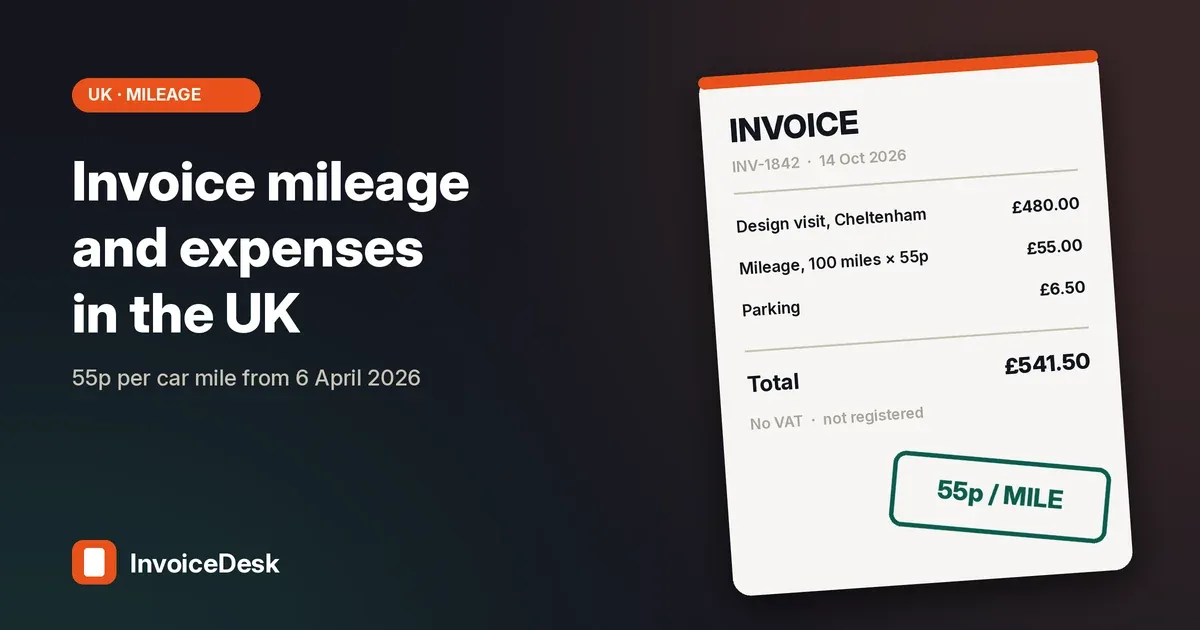
The round trip is 100 business miles. From 6 April 2026 the approved car rate is 55p, so mileage is 100 × £0.55 = £55.00. Parking is £6.50.
Invoice INV-1842, issued 14 October 2026, could read:
- Design visit and layout plan, Cheltenham, 14 October 2026: Qty 1 at £480.00 = £480.00.
- Business mileage, Birmingham to Cheltenham return, 100 miles at £0.55: Qty 100 at £0.55 = £55.00.
- Parking, Cheltenham, 14 October 2026: Qty 1 at £6.50 = £6.50.
- Subtotal: £541.50.
- VAT: none, because she is not VAT registered.
- Total due: £541.50.
- Payment due by 28 October 2026, using Net 14 from the invoice date.
If the same visit had been billed at the old 45p car rate, mileage would have been £45.00 and the invoice total £531.50. The April 2026 change is £10.00 on this trip, which is why the quote should say whether you use "the HMRC approved car rate from time to time" or a fixed pence-per-mile figure.
Samira's tax return is a separate calculation. If she uses simplified expenses for her car, GOV.UK allows her to deduct 55p a mile for the first 10,000 business miles in the 2026 to 2027 tax year, then 25p. Parking can be claimed on top. If she has already driven 10,000 business miles earlier in the tax year, her deduction for these 100 miles would be 100 × 25p = £25.00, even though the client still pays the agreed 55p. Charging the client and calculating your own tax deduction are not the same sum.
VAT on mileage and expenses if you are registered
If you are not VAT registered, skip this section and do not charge VAT on fees or expenses.
If you are VAT registered, GOV.UK's guidance on VAT: costs or disbursements passed to customers distinguishes recharges from disbursements. Your own travel is almost always a recharge. GOV.UK says incidental costs such as travelling expenses and your own postage are not disbursements, because you incurred them in making your own supply. If you itemise them, you still have to charge VAT, whether or not you paid any VAT yourself. The official example is an airline ticket you buy to visit a client: if you recharge it, you must charge VAT, because the flight was for you, not for the client. A mileage charge for driving your own car to the job is the same kind of cost.
GOV.UK's worked invoice for a London website consultant visiting Edinburgh shows:
- Design services: £2,500.
- Travelling expenses: £300.
- Amount on which VAT is due: £2,800.
- VAT at 20%: £560.
- Website hosting purchased on the client's behalf, treated as a disbursement: £150.
- Total including VAT: £3,510.
The £300 travel sits inside the VAT calculation. The £150 hosting can be left out of VAT only because it met GOV.UK's disbursement tests: it was bought for the client, as their agent, passed on at the exact cost as a separate line, and was additional to the consultant's own services. Parking, fuel or a train ticket in your name, used so you can deliver the work, will usually fail those tests.
If Samira were VAT registered, the supply was standard-rated, and none of the lines were disbursements:
- Net fees and expenses: £541.50.
- VAT at 20%: £108.30.
- Total due: £649.80.
Use the VAT calculator to add 20% to a net figure or take VAT out of a gross one. If you charge VAT on a recharge, you may be able to reclaim VAT you paid on that cost if you have a valid VAT invoice or receipt. You cannot reclaim VAT on a disbursement you left out of your own VAT calculation.
How to build this invoice
The UK invoice generator opens with United Kingdom defaults: pounds sterling, VAT presets and A4.
- Set the Invoice no., Issue date and Payment terms. Choose Net 14 or Net 30, then confirm the Due date is a real calendar date.
- Under Your business, enter your business or your name, address and, if you are VAT registered, your Tax ID (the VAT registration number).
- Add the client name and address under Bill to.
- Under Items, add the professional fee as its own line. Fill in the description, Qty and Rate.
- Choose + Add item for the mileage line. Put the number of miles in Qty and the pence-per-mile figure in Rate, written in pounds. For 55p, Rate is 0.55. The line total should equal miles times the rate.
- Add parking or other agreed expenses as further lines, with the date and place in the description.
- If you are VAT registered, pick a Tax preset of 20% for standard-rated lines, or the rate that actually applies, and keep Prices are set to Tax added on top unless you quoted inclusive prices. If you are not registered, do not add a VAT line.
- If a cost is a genuine disbursement, keep it on a separate line, show the exact amount you paid, and do not apply VAT to that line.
- Use Notes to say that a mileage log or receipts are available. Put the sort code, account number and payment reference in Payment details.
- Check the on-page checklist, then download the PDF.
Do not bury mileage inside a single "design visit" total if you agreed to itemise it. Keep the date, destination, purpose and miles for each billed journey, plus receipts, so you and the client can reconstruct the charge.
Frequently asked questions
Can I charge a client more than 55p a mile?
Yes, if they agreed to that rate. The HMRC figure is a tax rate, not a cap on commercial invoices. You can also charge less, or include travel in your fee and invoice no mileage at all.
Should I still use 45p on invoices issued after 6 April 2026?
Only if that is what you agreed. For tax, the approved car and van rate for the first 10,000 miles is 55p from 6 April 2026. If your terms say "current HMRC approved car rate", update new invoices to 55p. If a quote already locked 45p, honour that quote unless you both change it.
Is my commute billable mileage?
Whether a client pays for commuting depends on your agreement; that does not make it deductible business mileage. Travel to your own regular workplace is generally private for tax purposes, and the tax eligibility of a client-site journey depends on the circumstances.
Do I add VAT to mileage if I am VAT registered?
Usually yes. GOV.UK treats your own travelling expenses as recharges, not disbursements. Charge VAT on them unless a specific relief or exception applies to that supply.
Can I invoice actual fuel instead of a mileage rate?
Yes, if the client agreed to pay actual fuel, or a hire-car cost, rather than a per-mile rate. Show the date, the journey and the amount, and keep the receipt. Do not invoice both a full mileage rate and the fuel for the same miles unless the contract separates those charges.
What if I billed the wrong mileage?
Do not silently edit an invoice you have already sent. If you overcharged, issue a credit note for the difference, or credit the whole invoice and send a corrected one. If you undercharged, agree the correction before you send another invoice for the balance. If the client already paid a deposit, show it in Amount paid so the balance due is correct.
Related tools
- Compare freelance day rates
- Create a quote that states the mileage rate
- Start from a freelancer invoice layout
This article is general information, not tax, accounting or legal advice. Check your agreement and the current GOV.UK pages before you invoice a client or complete a tax return.