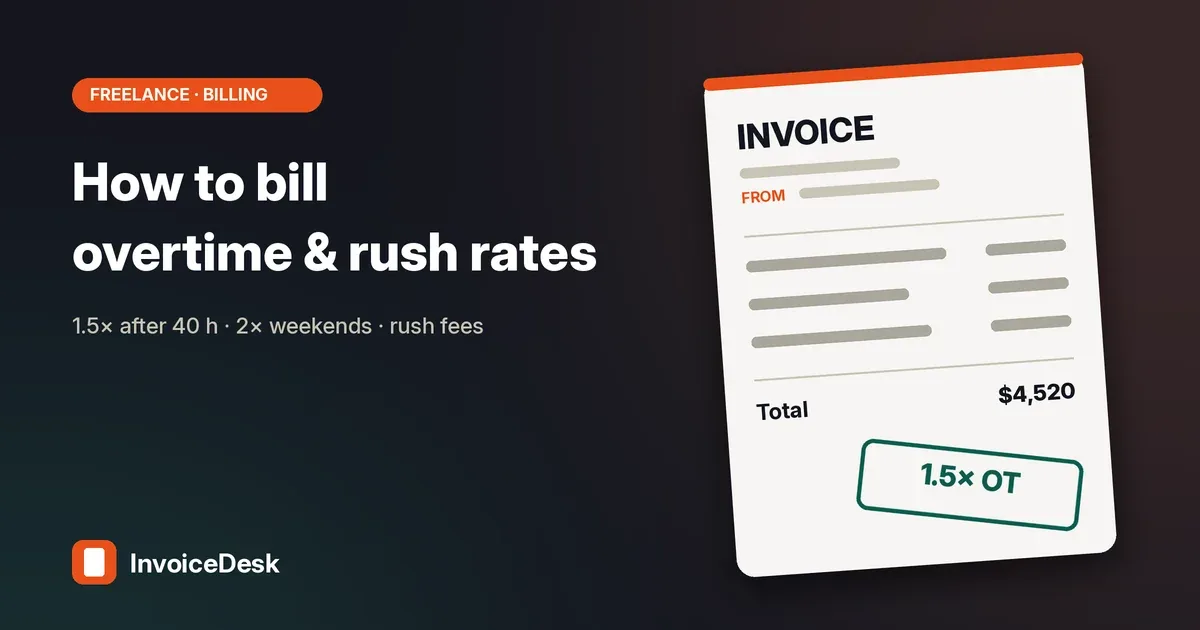
A client asks you to "just push through the weekend", or a launch date moves forward and you end up working evenings to hit it. If you are a freelancer or independent contractor, nobody is obliged to pay you extra for those hours unless you agreed it in advance, and nobody will pay it unless it is clearly on the bill. This guide shows how to set up overtime, rush and after-hours rates, and how to lay them out as separate lines in a free online invoice generator so the client can check every number.
It is written for freelancers, consultants and trades in the US, UK, Canada, Australia, New Zealand and Ireland. The maths is the same everywhere; what changes is the contract you sign and the tax you add on top.
Quick answer: overtime for a contractor is a contract term, not a legal right. Agree a premium (for example 1.5× after 40 hours a week, 2× for weekends, or a rush surcharge) in writing before the work starts. On the invoice, put standard hours, overtime hours and any rush fee on separate lines, each with its own quantity and rate, and reference the clause that allows it.
Why contractors don't get "automatic" overtime
Employees and contractors sit under different rules, and that difference is the whole reason overtime has to be written into your agreement.
- United States. The U.S. Department of Labor explains that under the Fair Labor Standards Act, covered non-exempt employees must get at least time and one-half their regular rate for hours over 40 in a workweek. That rule applies to employees. An independent contractor is in business for themselves; the IRS describes the difference between the two on its independent contractor or employee page. If you are a 1099 contractor, any overtime premium is whatever your contract says.
- United Kingdom. GOV.UK's overtime rights page says employers do not have to pay workers for overtime at all (as long as average pay stays above the National Minimum Wage), and that overtime rates usually come from the employment contract. For a self-employed contractor, the same principle is even stronger: your client contract is the only source of an overtime rate.
- Canada, Australia, NZ, Ireland. Each has employment standards for employees, but a genuine business-to-business contractor sets premiums by agreement, the same way.
One caution: if a client controls your hours, tools and methods like an employer would, you may be misclassified. That is a separate question, and our guide to W-9 and 1099 rules is a good starting point for US contractors.
The four ways to charge more for extra hours
Pick one model, write it into your quote or contract, and use the same wording on the invoice.
1. A weekly threshold (time and a half after 40 hours)
This mirrors employee overtime and is easy for clients to understand. Hours up to an agreed weekly limit are billed at your standard rate; hours above it are billed at a multiplier, usually 1.5×. It suits long engagements and staff augmentation work where you are effectively booked full-time.
2. Out-of-hours or weekend rates (double time)
Instead of counting total hours, you charge a higher rate for when the work happens: evenings, weekends or public holidays at 1.5× or 2×. This is common for IT support, events, trades call-outs and anything where the client needs you outside normal business hours.
3. A rush or expedite surcharge
For fixed-price work, a percentage surcharge (often somewhere between 25% and 100%, depending on your field) for delivering faster than your standard turnaround. It prices the disruption, not the hours. Put it on its own line rather than quietly raising the project fee, so the client sees what speed cost them.
4. A minimum call-out or minimum billable block
Trades and support contractors often bill a minimum (for example two hours) for any emergency call-out, regardless of how long the fix took. It can be combined with an out-of-hours multiplier.
Which multiplier should you use?
There is no official figure for contractors. 1.5× ("time and a half") and 2× ("double time") are the most widely recognised because they match common employee overtime practice, which makes them easy to defend. Whatever you choose, check that your base rate already covers your costs before you add premiums; the freelance hourly rate calculator helps with that, and our freelance rate guide covers how to set day and project rates.
Put it in writing before you start
A premium that first appears on the invoice is the one most likely to be disputed. Add a short clause to your quote, statement of work or contract. Example wording you can adapt:
Standard hours are billed at $80 per hour, up to 40 hours per week (Monday to Sunday). Hours above 40 in a week, when requested by the client, are billed at 1.5× the standard rate. Work the client requests on weekends or between 8 pm and 7 am is billed at 2× the standard rate. Rush delivery inside 48 hours carries a 25% surcharge on the fixed fee. Overtime is only billed when the client has asked for the work in writing.
That last sentence matters. It stops a client arguing that you chose to work late, and it gives you an email trail to point to.
Also agree:
- The week you count from. The DOL notes that a workweek is a fixed, recurring 168-hour period that does not have to match the calendar week. Pick one (for example Monday 00:00 to Sunday 23:59) so both sides count the same way.
- Whether double-time hours also count toward the weekly threshold. The simplest rule is that each hour is billed once, at the highest rate that applies.
- How you round time. If you bill in 6- or 15-minute blocks, say so. Our post on billing in six-minute increments explains the common options.
Worked example: a developer's weekly invoice with overtime
Maya is a freelance web developer in the US. Her contract sets $80 per hour standard, 1.5× for hours above 40 a week, and 2× for weekend work the client requests. In the week of 2 to 8 November she logs:
- Monday to Friday: 46 hours of development (client asked in writing for extended days before a launch).
- Saturday: an emergency fix, 3 hours 45 minutes, requested by the client by email.
Step 1: convert minutes to decimals. 3 hours 45 minutes is 3.75 hours, not 3.45. The time to decimal calculator converts a list of entries at once.
Step 2: split the weekday hours. 40 hours at the standard rate, 6 hours of overtime.
Step 3: work out each rate.
- Overtime rate: $80 × 1.5 = $120 per hour
- Weekend rate: $80 × 2 = $160 per hour
Step 4: work out each line.
- Standard hours: 40 × $80 = $3,200.00
- Weekday overtime: 6 × $120 = $720.00
- Weekend emergency work: 3.75 × $160 = $600.00
Step 5: total. $3,200 + $720 + $600 = $4,520.00 before any sales tax.
The weekend hours are billed once at 2× and are not also counted toward the 40-hour threshold, which matches the clause above. You can check the split in the overtime calculator: enter $80, choose "Regular and overtime hours" (40 and 6), keep the multiplier at "1.5× (time and a half)", and add 3.75 in the double-time hours box. Its "Put on an invoice" link carries the figures across.
How to lay out overtime on the invoice
Use the invoice generator's Items section and add one item per rate with + Add item. For Maya's week:
- Description: "Web development, standard hours (week of 2–8 Nov)". Qty: 40. Rate: 80.
- Description: "Overtime, weekday hours over 40 at 1.5× (requested 3 Nov)". Qty: 6. Rate: 120.
- Description: "Weekend emergency fix at 2×, Sat 7 Nov (requested by email)". Qty: 3.75. Rate: 160.
Then:
- In Notes, reference the agreement: "Overtime and weekend rates per clause 4 of the statement of work dated 1 October 2026."
- Choose a due date under Payment terms (Net 15 or Net 30 are common).
- Attach the timesheet. If you logged start and end times, the timesheet invoice generator can export them as CSV or a printable sheet, and send the lines straight into the invoice.
- Click Download PDF or Print to send it.
Why separate lines instead of one blended rate? A client's accounts team can match each line to the contract in seconds. A single line such as "49.75 hours, $4,520" forces them to reverse-engineer your maths, and that is when payments stall.
Showing a rush surcharge
For fixed-price work, list the project fee and the surcharge separately:
- "Landing page design and build (fixed fee)", Qty 1, Rate 1,000
- "Rush delivery surcharge, 25% (48-hour turnaround requested 4 Nov)", Qty 1, Rate 250
If you prefer, you can show the surcharge as a positive "Shipping / extras" amount, but a named line item is clearer and easier to reference.
Tax on overtime lines
The premium is simply part of the price of your service, so it is normally taxed the same way as the rest of the invoice:
- UK, Ireland, EU: if you are VAT-registered and charge VAT on the service, VAT is normally charged on the overtime and rush lines too.
- Australia and New Zealand: if you are GST-registered, GST normally applies to the whole taxable supply, including premiums.
- Canada: if you are registered for GST/HST, the same applies.
- US: sales tax on services depends on the state and the type of service; many professional services are not taxed, but some are.
Treat this as general information and check with your accountant if you are unsure.
Common mistakes to avoid
- Billing overtime nobody asked for. If you chose to work late to catch up, it is usually your cost, not the client's.
- Writing minutes as decimals. 7 hours 30 minutes is 7.5, not 7.3.
- Counting the same hour twice. Weekend hours at 2× should not also push the weekday total past 40.
- Hiding the premium in a higher hourly rate. It looks like a price rise and invites a dispute.
- Waiting weeks to invoice. Bill overtime in the same period it was worked, while the client still remembers asking for it.
FAQ
Can a freelancer legally charge overtime?
Yes, if the client agrees to it. In the US the FLSA overtime rule covers employees, not independent contractors, so a contractor's overtime rate comes from the contract. The same principle applies in the UK and other markets.
What is time and a half for $50 an hour?
$50 × 1.5 = $75 per hour. Double time would be $100 per hour.
Should I charge overtime on a fixed-price project?
Usually not by the hour. Use a rush surcharge or a change request instead, because the client agreed to a price for the result, not for your hours.
Do I need to show the multiplier on the invoice?
It is not required, but writing "at 1.5×" or "at 2×" in the description makes the line self-explanatory and quicker to approve.
What if the client refuses to pay the overtime lines?
Point to the clause and the written request for the extra work. If there was no agreement in advance, you may only be able to bill those hours at your standard rate. Keep the conversation polite and documented.
Related tools
- Time card calculator with lunch breaks and overtime
- Free quote and estimate generator
- Payment terms explained, from Net 30 to EOM
This article is general information, not legal or tax advice. Rules and rates differ by country, state and contract, so check your agreement and speak to an adviser for your situation.