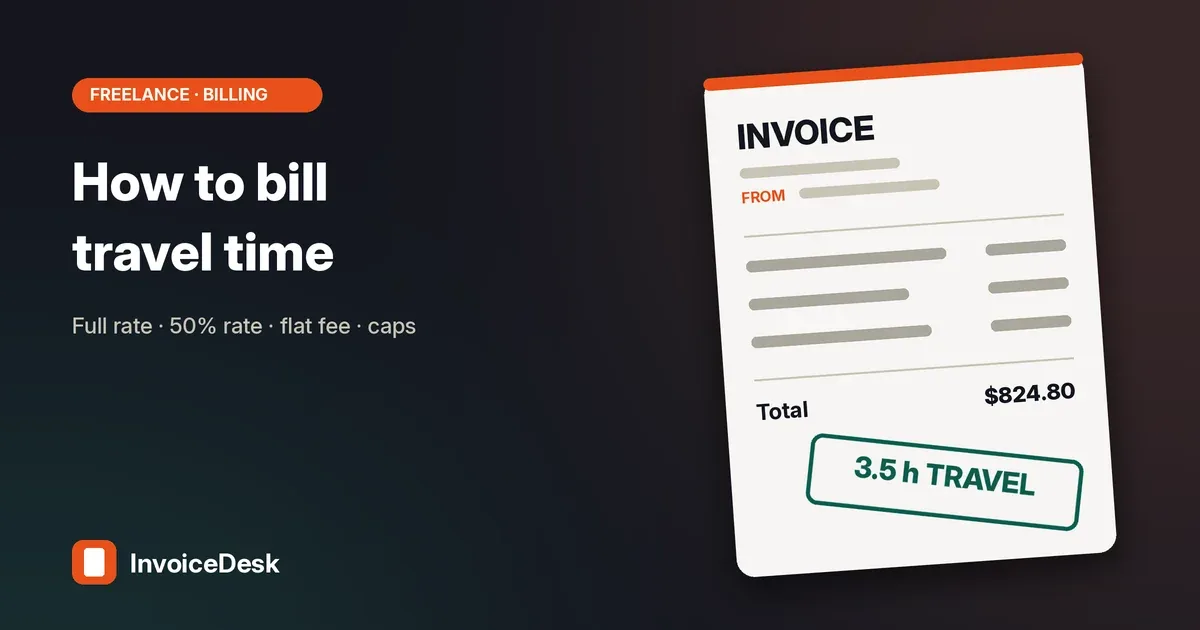
You drove two hours to a client site, worked for six, and drove two hours home. Is that six billable hours, or ten? There is no single legal answer for freelancers and contractors. Travel time is a commercial term you agree with the client, and the invoice is where that agreement either looks professional or starts an argument. This guide shows the common ways to charge for travel time, how to write it into a quote, and how to lay it out as clear lines in a free online invoice generator.
It is written for freelancers, consultants, trades and other independent contractors in the US, UK, Canada, Australia, New Zealand and Ireland. The arithmetic is the same everywhere. What changes is the contract you sign and the sales tax, VAT or GST you add on top.
Quick answer: agree a travel policy before the job starts (full rate, a reduced travel rate, a flat travel fee, or travel included in your price). On the invoice, put travel time on its own line with the date, the route, the hours in decimal and the travel rate, and keep mileage, fares and parking on separate expense lines. If you charge VAT or GST, travel time is part of your service, so it is taxed like the rest of the work.
Is travel time billable at all?
For an employee, travel time can be governed by employment law. For a self-employed contractor billing a business client, it is whatever your agreement says. Nothing stops you charging for it, and nothing obliges the client to pay it if it was never agreed. That is why the most important step happens before you travel, not when you invoice.
Clients usually accept travel time when:
- The trip is unusual for the job (a site visit in another city, a one-off workshop, an emergency call-out).
- You cannot do other paid work while travelling (driving, for example).
- The rate and any cap were written in the quote, so the line on the invoice is no surprise.
Clients usually push back when:
- Travel appears on the invoice for the first time, with no earlier mention.
- It is your normal commute to a regular place of work for that client.
- The travel hours look large compared with the work (four hours of travel for one hour on site), with no explanation.
Five common ways to charge for travel time
Pick one model, write it into your quote or contract, and use the same words on the invoice. Mixing models from job to job is what confuses clients.
1. Full hourly rate
Travel is billed exactly like work. This is common for specialist consultants, emergency trades and anyone who could otherwise be doing billable work in those hours. It is simple, but it is also the model clients are most likely to question on long trips.
2. A reduced travel rate (often 50%)
Travel hours are billed at a fraction of your standard rate, for example half rate. Many freelancers see this as the fairest middle ground: the client pays for your time out of the office, but not at the same price as expert work. If you use this model, show both the percentage and the resulting rate on the invoice ("Travel time at 50% of standard rate, $45/h").
3. Free allowance, then billable
The first part of each journey is free (for example the first 30 or 60 minutes each way), and only time beyond that is billed. This is popular with local trades: nearby jobs carry no travel line, while distant jobs pay for the extra distance. Write the allowance into your terms so the invoice can say "Travel beyond 30-minute allowance".
4. Flat travel or call-out fee
Instead of counting hours, you charge a fixed amount per visit or per zone ("Zone 2 call-out: $60"). Clients like knowing the number in advance, and you avoid tracking travel minutes. The risk is underpricing when traffic or delays turn a one-hour trip into three, so build in a margin.
5. Travel built into your price
Your hourly or day rate already includes typical travel, and you never show a travel line. This keeps invoices clean, especially for regular clients. To make it work, include travel days in your rate maths. Our hourly rate calculator lets you set a billable share of your working time; non-billable travel is one of the things that pulls that share down.
Rules worth agreeing in advance
Whichever model you choose, a few extra terms prevent most disputes. Put them in your quote, proposal or contract, for example with a free quote generator:
- Door to door or from a base? Say where travel time starts and ends: your home office, your workshop, or the nearest town.
- A daily cap. For long trips, cap billable travel at, say, 8 hours per day, so a long-haul flight cannot produce a 20-hour travel line.
- Working while travelling. If you do client work on a train or plane, bill those hours as work at your normal rate, not as travel, and do not bill the same hours twice.
- Shared trips. If one trip serves two clients, split the travel time between them, and say so in each invoice.
- Waiting time. Decide whether delays on site, flight delays and waiting for access count as travel, work or nothing.
- Rounding. State whether you round travel to the nearest 15 minutes, six minutes or exact minutes. Our guide to billing in six-minute increments explains the trade-offs.
A simple clause might read: "Travel time is charged at 50% of the standard hourly rate, from our office to the client site and back, capped at 6 hours per day. Mileage is charged separately at the agreed rate per mile. Parking, tolls and fares are recharged at cost with receipts."
Travel time vs travel expenses
Travel time and travel costs are two different things and belong on different lines:
- Travel time is your labour: hours multiplied by a rate.
- Mileage is a vehicle cost: distance multiplied by an agreed rate per mile or kilometre. Our mileage reimbursement calculator does the multiplication.
- Fares, parking, tolls and accommodation are costs you paid, usually recharged at cost with receipts.
Keeping them apart lets the client approve each part against the agreement. For the UK, including HMRC's mileage figures and how VAT applies to recharged expenses, see how to invoice mileage and expenses in the UK.
How to write travel time on an invoice
A clear travel line answers four questions: when, where, how long, and at what rate. In the InvoiceDesk generator, use + Add item for each line and fill in the description, Qty and Rate:
- Description: "Travel time, 14 Nov 2026, Leeds office to client site in York and return (at 50% of standard rate)".
- Qty: the hours in decimal, for example 3.5 for three and a half hours.
- Rate: the travel rate per hour.
Most invoicing tools, including ours, expect decimal hours in the quantity field. If you logged 1 hour 45 minutes each way, that is 3 hours 30 minutes, or 3.5 hours. Use the time to decimal calculator if your times are awkward, such as 2 h 37 min.
If you bill travel across many visits in a month, a timesheet invoice generator keeps each day's work and travel visible without one huge line.
Finally, add a short note at the bottom of the invoice that points to the agreement, for example "Travel charged per clause 4 of the quote dated 3 Nov 2026."
Worked example: a consultant's site visit
A freelance consultant charges $90 per hour. Their quote says travel time is billed at 50% of the standard rate ($45 per hour), mileage at an agreed $0.70 per mile, and parking at cost.
For one site visit they record:
- Drive to the client: 1 hour 45 minutes.
- Work on site: 6 hours 15 minutes.
- Drive home: 1 hour 45 minutes.
- Distance: 62 miles each way, 124 miles in total.
- Parking: $18.00, with a receipt.
Convert the times to decimals: travel is 1.75 + 1.75 = 3.5 hours, and the on-site work is 6.25 hours.
The invoice lines are:
- Consulting, on-site workshop, 14 Nov 2026: 6.25 h × $90.00 = $562.50
- Travel time, office to client site and return, at 50% of standard rate: 3.5 h × $45.00 = $157.50
- Mileage, 124 miles × $0.70 (agreed rate) = $86.80
- Parking, client site (receipt attached): 1 × $18.00 = $18.00
Subtotal: $562.50 + $157.50 + $86.80 + $18.00 = $824.80, plus any sales tax that applies to the consultant's services in their state.
Compare the alternatives on the same trip. At full rate, travel would be 3.5 × $90 = $315.00, which is $157.50 more. With a 30-minute free allowance each way, the billable travel would be 3.5 − 1.0 = 2.5 hours, so 2.5 × $45 = $112.50 at the reduced rate. A flat Zone 2 fee of $120 would replace the travel time line entirely. None of these is "right"; what matters is that the invoice matches the quote.
VAT, GST and sales tax on travel time
If you are registered for VAT or GST, travel time is not a separate pass-through cost. It is part of the service you supply, so it is normally taxed at the same rate as the rest of your work.
In the UK, GOV.UK's guidance on VAT costs or disbursements passed to customers says items like your own travelling expenses are not disbursements, and that if you recharge an airline ticket you bought to visit a client, you must charge VAT because the flight was for you, not for the client. If your travel costs carry VAT, travel time, which is your own labour, clearly does too. A UK consultant billing 3.5 hours of travel at £40 per hour would show £140.00 as a standard-rated line, with 20% VAT of £28.00 added along with the rest of the invoice. Check the UK VAT invoice requirements for what else the invoice must show.
The same logic generally applies to GST in Australia, New Zealand and Canada: if your service is taxable, the travel time you charge as part of it is usually taxable too. In the US, whether services are subject to sales tax depends on the state and the type of service, so check your state's rules or use the sales tax calculator once you know the rate.
Step-by-step checklist
- Choose a travel model: full rate, reduced rate, free allowance, flat fee, or included in price.
- Write it into the quote, with a start point, a daily cap and your rounding rule.
- Log departure and arrival times for every trip, plus miles and receipts.
- Convert times to decimal hours before you build the invoice.
- Add separate lines for work, travel time, mileage and other costs.
- Apply VAT, GST or sales tax to travel time the same way as your other work.
- Reference the clause in the invoice notes and send it with your normal payment terms.
FAQ
Can I charge for travel time if it was not in the quote?
You can ask, but the client is not obliged to pay a charge they never agreed. If it was not in writing, consider absorbing it this time and adding a travel clause to future quotes. Raising it as a surprise on the final invoice is the most common cause of travel disputes.
Is it normal to charge half rate for travel?
It is a common compromise, but not a rule. Some professionals bill full rate, some bill nothing for local trips, and some use a flat fee. Pick what fits your market and keep it consistent.
Should I bill travel time for my regular commute?
Most clients will not expect to pay for travel to a place you work at regularly, for the same reason employees are not paid for commuting. Travel time is easier to justify for one-off visits and distant sites.
How do I show travel time when I bill a day rate?
Either state that the day rate includes travel within an agreed area, or add a separate travel line for trips outside it. Some contractors bill a half day for a full travel day when no on-site work happens.
Do I charge VAT or GST on travel time?
If you are registered and your service is taxable, yes, normally. Travel time is part of your own service, so it is taxed like the rest of your work. Disbursement treatment is for certain costs paid as the client's agent, not for your own time.
Can I put travel time and mileage on one line?
You can, but it makes the invoice harder to check. Separate lines for hours and for miles let the client compare each one with the agreement and approve faster.
Related tools
- Free invoice generator with line items, tax and PDF download
- Time to decimal calculator for hours and minutes
- Mileage reimbursement calculator
- Freelance hourly rate calculator
- Day rate calculator for contractors
This article is general information, not legal or tax advice. Rules and rates differ by country, state and contract, so check your agreement and speak to an adviser for your situation.