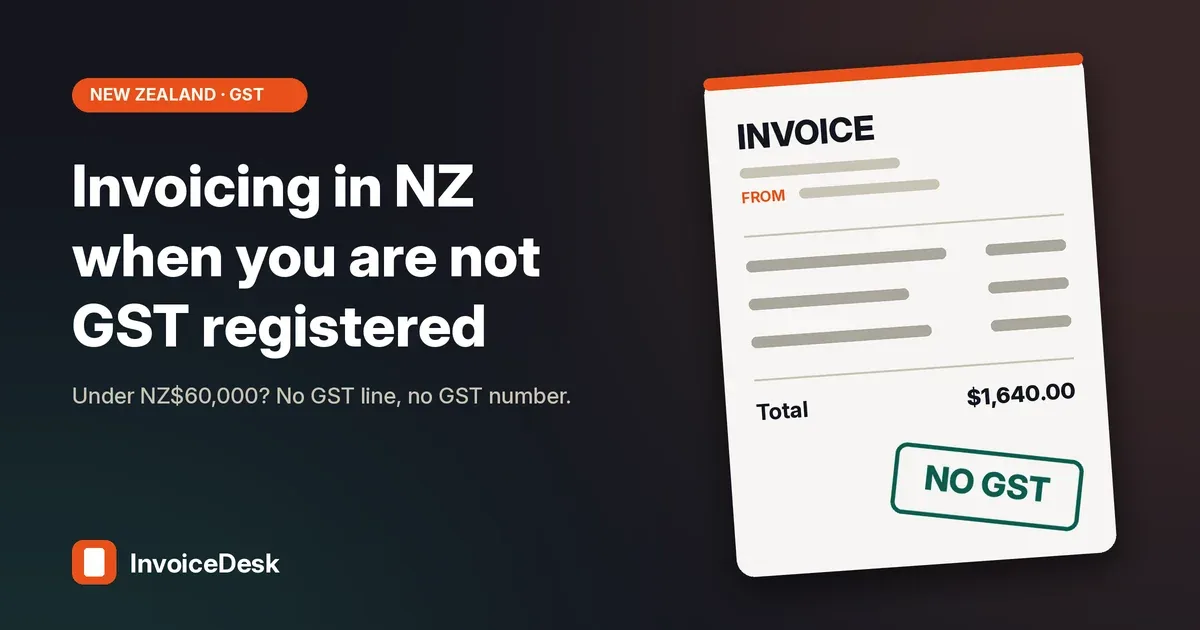
If you are a sole trader, freelancer or contractor in New Zealand and you are not registered for GST, your invoices should look a little different from the ones most templates produce. You do not add 15% GST, you do not show a GST number, and you should not head the document "Tax Invoice". You still need a clear, numbered invoice to get paid on time and to back up the income on your tax return, and our free New Zealand invoice generator can make one without GST.
This guide explains when Inland Revenue (IRD) says you must register, what an invoice from a non-registered business should include and leave out, how to keep an eye on the NZ$60,000 threshold, and how to make the invoice in a couple of minutes.
Quick answer: if you are not GST registered, send a document headed "Invoice" with your name and contact details, your client's name, a unique invoice number, the date, a description of the work and the total in NZ dollars. Do not add GST, do not quote a GST number, and add a short line such as "Not registered for GST. No GST has been charged."
Do you need to register for GST in New Zealand?
IRD's page on registering for GST starts with a point many new freelancers miss: you do not have to register for GST just because you start a business. It then says you must register if you carry out a taxable activity and either:
- your turnover was at least $60,000 in the last 12 months, or you expect it to be at least $60,000 in the next 12 months, or
- you add GST to the price of the goods or services you sell.
That second point matters. If you are not registered, you cannot quietly add 15% to your prices and keep it. Charging GST is something you do once you are registered.
How the 12-month test works
New Zealand's test is a rolling one. It is not tied to the tax year or the calendar year. At any point, you look back over the last 12 months and forward over the next 12 months. If either figure reaches $60,000, registration becomes compulsory.
In practice that means two simple habits:
- Keep a running total of your sales for the last 12 months, updated every time you invoice.
- Before you accept a large job or a long contract, ask whether it will push your next 12 months to $60,000 or more.
The forward-looking test catches people out. A designer who has earned $35,000 in the past year but has just signed a $3,000-a-month retainer for the next 12 months is already looking at more than $60,000 ahead, even though the past figure is well under it.
Registering voluntarily
You can register even if you are below $60,000. IRD's page on registering for GST voluntarily lists the trade-offs. The advantages include being able to claim GST on expenses related to your taxable activity, and it can help you keep on top of your paperwork. The disadvantages are that you need to add GST to your prices, file returns regularly, and face penalties if returns or payments are late.
Voluntary registration often suits people who sell mainly to GST-registered businesses (who can claim back the GST you charge) and who have significant GST-inclusive costs such as equipment. It suits people who sell mainly to the public less well, because 15% on top of the price is a real increase for a customer who cannot claim it back. If you are unsure, talk to an accountant before you register.
What to put on an invoice when you are not GST registered
IRD's rules on taxable supply information are written for GST-registered suppliers. They say taxable supply information must be provided to GST-registered buyers within 28 days of a request for supplies over $200. If you are not registered, those rules do not turn your invoice into a GST document. Our separate guide to NZ taxable supply information covers what registered businesses must show.
For a non-registered business, a good invoice includes:
- The word "Invoice" as the heading. Not "Tax Invoice".
- Your name or trading name and contact details. Add your NZBN if you have one; it is optional for sole traders.
- Your client's name and, for a business client, their address or email.
- A unique invoice number that follows a sequence, such as INV-0042. Our invoice numbering guide shows simple formats.
- The invoice date, and the date or period of the work if different.
- A description of each item: hours, days, a fixed fee or products.
- Amounts for each line and a total, in NZ dollars unless you agree otherwise.
- Payment terms: a due date and your bank account number in the 00-0000-0000000-00 format, with a payment reference.
- A note that you are not registered for GST.
For a general checklist that works in any country, see what to include on an invoice.
What to leave off
- No GST line. Not even "GST 0%". A zero line can look like you are registered and making a zero-rated supply, which is a different thing.
- No GST number. IRD says that when you do register, your GST number will be the same as your IRD number. Until then, do not put your IRD number in a GST number field.
- No "Tax Invoice" heading and no "GST inclusive" wording.
Wording for the note
Pick one and keep it on every invoice:
- "Not registered for GST. No GST has been charged."
- "GST not applicable: supplier is not registered for GST."
- "Prices do not include GST. The supplier is not GST registered."
The note saves a round of emails with your client's accounts team, who will otherwise ask where your GST number is.
Worked example: a freelance photographer in Wellington
Mere is a self-employed photographer in Wellington. She is not registered for GST. Her sales for the 12 months to the end of October 2026 add up to $41,200, and she has no large contracts lined up.
In November she photographs a product launch for a local company. Her invoice looks like this:
- Heading: Invoice
- From: Mere Ngata Photography, Wellington, hello@example.co.nz
- To: Harbourside Goods Ltd, 18 Customhouse Quay, Wellington
- Invoice number: MN-2026-058
- Invoice date: 12 November 2026
- Due date: 26 November 2026 (14 days)
- Line 1: Event photography, half day, $780.00
- Line 2: Editing and retouching, 6 hours × $95.00 = $570.00
- Line 3: Online gallery and licence for marketing use, $290.00
- Total due: $1,640.00
- Note: Not registered for GST. No GST has been charged.
- Payment details: Bank, account name, account number and reference MN-2026-058
The total is simply $780 + $570 + $290 = $1,640. There is no GST line and no GST number.
Checking the threshold
Mere's rolling total after this invoice is about $42,840, assuming nothing from November 2025 drops out of the window. That leaves roughly $17,000 of headroom under $60,000.
Now suppose the company offers her a monthly content retainer of $2,000 for the next 12 months. Together with her usual work, her expected sales for the next 12 months would clearly reach $60,000. Under IRD's forward-looking test, she would need to register for GST, and from then on she would charge GST and issue taxable supply information to registered clients. The right time to talk to IRD or an accountant is before she signs the retainer, so she can price it with GST in mind.
If you want to see what a price looks like with GST added or removed, our GST calculator does the 15% maths both ways.
How to make this invoice in InvoiceDesk
Our free New Zealand invoice generator uses NZ dollars, day-month-year dates and 15% GST by default, so a few changes give you a clean non-GST invoice:
- Open the generator and type "Invoice" in the Document title field. The New Zealand edition defaults to "Tax Invoice", which is wrong if you are not registered.
- Enter your details and your client's. Leave the GST number and Client GST / NZBN fields blank, or put your NZBN in the NZBN field if you have one.
- Add each line of work with its quantity and price.
- Open Tax, discount and totals and remove the GST line with the ✕ (Remove tax line) button. You should see "No tax lines" once it has gone. The Not GST registered – no GST preset sets GST to 0%, but it still leaves a GST line on the invoice, so removing the line is cleaner.
- Under Notes, payment and signature, add your not-registered note and your bank account details.
- Click Save as profile so your settings are ready next time, then download or print the PDF.
Everything runs in your browser with no sign-up. Your invoice data is not uploaded to us.
Income tax still applies
Not charging GST does not make your income tax-free. As a sole trader you pay income tax on your business profit, and your invoices are the main evidence of what you earned.
IRD's provisional tax page explains that you will have to pay provisional tax if you had to pay more than $5,000 of tax at the end of the year from your last return. Provisional tax is paid in instalments during the following year, so a good year of freelancing can mean extra payments the next year. Plan for it by setting aside part of every invoice.
If you work as a contractor in certain kinds of labour-based work, your client may deduct tax before paying you. IRD calls these schedular payments. If that applies to you, your invoice still shows your full fee, and the payer deducts the tax when they pay. Check with IRD whether your work falls into these categories.
Keep your records for seven years
IRD's record keeping page says to keep all your records, including electronic ones, for at least 7 tax years, and that your records must be in English or Māori unless IRD approves another language. Keep a copy of every invoice you send, plus receipts for your expenses. Our guide on how long to keep invoices compares the rules in other countries.
Clients outside New Zealand
Many New Zealand freelancers work for clients in Australia, the US or the UK. You can invoice in their currency if you agree to, and our guide to invoicing in a foreign currency covers exchange rates and bank fees. IRD also publishes guidance on converting overseas currency to NZ dollars for your tax records.
If you are counting towards the $60,000 threshold, include those overseas sales in your running total and get advice on how GST would treat them before you register.
Common mistakes
- Heading it "Tax Invoice". Use "Invoice" until you are registered.
- Adding GST anyway. IRD says adding GST to your prices is itself a reason you must register.
- Showing "GST 0%". Remove the line instead.
- Only looking backwards. The test also covers the next 12 months, so a big new contract can trigger registration on its own.
- Deleting a wrong invoice. Keep the sequence intact and issue a credit note to correct it.
- No due date. Every invoice needs one. Our payment terms page explains the common options.
If your customers are overseas, different rules can apply: see invoicing overseas clients from New Zealand.
FAQ
Can I invoice in New Zealand without a GST number?
Yes. If you are not registered for GST, you can invoice without a GST number. Do not charge GST and do not call the document a tax invoice.
What is the GST threshold in New Zealand?
IRD says you must register if your turnover from a taxable activity was at least $60,000 in the last 12 months or you expect it to be at least $60,000 in the next 12 months.
Is my IRD number my GST number?
When you register, IRD says your GST number will be the same as your IRD number. Before you register, do not show your IRD number as a GST number on invoices.
Should I write "GST exempt" on my invoice?
It is better not to. "Exempt" has a specific meaning for certain types of supply. If you are simply not registered, say so: "Not registered for GST. No GST has been charged."
Can a business refuse to pay an invoice without GST?
Your invoice is still a valid request for payment. A registered client simply has no GST to claim on it. The not-registered note usually answers their question straight away.
How long does GST registration take?
IRD says it processes registration requests within 10 working days and contacts you if it needs more information. You register through myIR.
Do I need an NZBN to invoice?
No. An NZBN (New Zealand Business Number) is optional for sole traders. Add it to your invoices if you have one.
Summary
If you are a sole trader in New Zealand and not registered for GST, keep your invoice simple: head it "Invoice", number it in sequence, describe the work, show a total with no GST, and add a one-line note that you are not registered. Track your sales on a rolling 12-month basis, look ahead as well as back, and register once you reach $60,000 or decide to register voluntarily. When you are ready, make your next invoice with the free New Zealand invoice generator.
Related tools
This article is general information, not tax advice. Rules change, so check the IRD pages linked above or speak to an accountant about your situation.