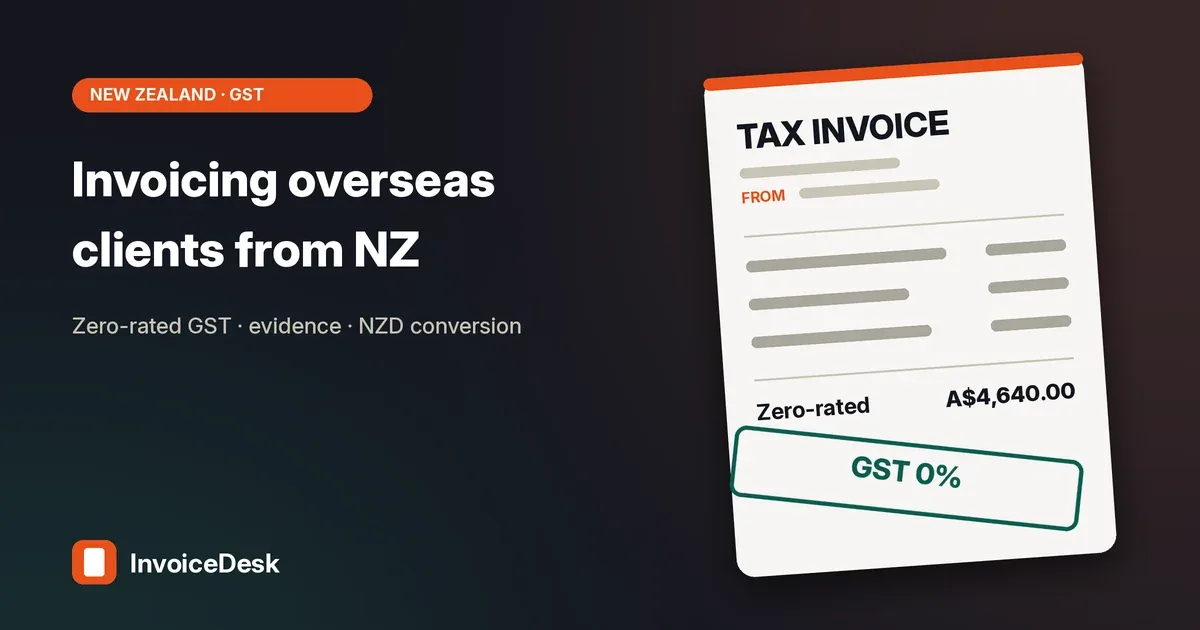
If you're GST-registered in New Zealand and your client is a company in Australia, the US or the UK, much of your work for them is probably zero-rated. That means GST is charged at 0%, not left off. You can build that invoice in the free NZ invoice generator: bill in AUD, USD or GBP and show the GST line at 0% for the exported work. The invoice looks almost like a domestic one. What changes is the GST rate, the evidence you keep, and how you report the sale.
This guide covers which exported services Inland Revenue (IRD) treats as zero-rated, the rules that most often stop zero-rating from applying, the evidence IRD accepts, how to convert a foreign-currency invoice into New Zealand dollars, and where the sale goes on your GST return. It ends with a full worked example: an Auckland designer billing a Sydney client for remote work plus a workshop held in Auckland.
Quick answer: under section 11A(1)(k) of the Goods and Services Tax Act 1985, services you supply to a non-resident who is outside New Zealand when you perform them are generally zero-rated. You charge GST at 0%, include the sale in your GST return (Box 5 and Box 6), and you can still claim GST on related business costs. Zero-rating usually stops applying when the work relates directly to land or goods in New Zealand, or when someone in New Zealand, such as the client's staff, receives the service here.
Zero-rated, exempt and "no GST" are different things
Three different situations all end with no GST on the invoice. Mixing them up leads to the wrong invoice and the wrong return.
Not registered for GST
If you're not GST-registered, you can't charge GST on any sale, domestic or overseas, and you can't claim GST on expenses. Your invoice is a plain "Invoice" with no GST line. Our guide to invoicing in New Zealand without GST registration covers that case. The registration test is turnover from your taxable activity of $60,000 in a 12-month period. IRD's IR375 GST guide describes turnover as the total value of your taxable supplies, and zero-rated sales are taxable supplies charged at 0%, so overseas work generally counts toward the threshold.
Exempt supplies
Exempt supplies, such as residential rent and most financial services, carry no GST, and IRD's GST guide says they stay out of your GST return altogether. You also can't claim the GST on costs that relate to them. Overseas client work is rarely exempt.
Zero-rated supplies
Zero-rated supplies are taxable supplies at 0%. IRD's GST guide (IR375, March 2026) lists exported goods as the classic example and says that if you have zero-rated supplies you can claim GST on your expenses. That's the big practical difference from exempt work. A designer who exports all her work can still claim back the GST on her laptop, software and co-working desk.
Which exported services are zero-rated?
IRD's zero-rated supplies page lists the categories of exported services. The ones freelancers and small firms meet most often are:
- Services supplied to non-residents who are outside New Zealand when the service is performed. IRD's example is a New Zealand lawyer giving legal advice to a person living in Australia. This rule covers most remote design, development, writing, consulting, marketing and admin work for overseas clients.
- Services physically performed outside New Zealand. IRD's example is a New Zealand singer performing overseas. If you fly to Melbourne to run an on-site audit, that part of the work is performed outside New Zealand.
- Services directly connected with land or buildings outside New Zealand, such as an architect designing a building for an overseas site.
- Services directly connected with goods located outside New Zealand when the service is performed.
- Services relating to copyright and similar rights for use outside New Zealand.
The legal source is section 11A of the GST Act. For most service businesses the key paragraph is 11A(1)(k): services supplied to a person who is a non-resident and outside New Zealand at the time the services are performed.
When zero-rating does not apply
The general non-resident rule has exceptions. These are the ones that catch people out.
The work relates directly to land or goods in New Zealand
Section 11A(1)(k) excludes services supplied directly in connection with land in New Zealand, and services directly connected with movable goods that are in New Zealand when you do the work. A valuation of an Auckland property for a Singapore owner, or repairs to a machine sitting in a Tauranga warehouse, normally carry 15% GST even though the client is overseas.
Someone in New Zealand receives the service
Section 11A(2) blocks zero-rating when it's reasonably foreseeable that the service will be received in New Zealand by another person, including an employee of the overseas client or a director of the client company. There's a carve-out: the block doesn't apply if that person receives the service while making taxable or exempt supplies, for example a GST-registered New Zealand business. In practice, a workshop delivered in Wellington to an overseas client's visiting staff is usually standard-rated at 15%, even though the client is based abroad and pays from abroad.
The client isn't really "outside New Zealand"
An individual who books you while on holiday in Queenstown is in New Zealand when the service is performed, so the non-resident rule doesn't help. Companies are trickier. Section 11A(3) treats a non-resident company as outside New Zealand even if it has a presence here, as long as that presence is minor or isn't effectively connected with your supply. If your client's New Zealand branch is the one you actually work with, take advice before zero-rating.
Evidence IRD accepts
IRD's zero-rating page says that for remote services you need to be able to show the customer isn't a New Zealand resident. You can use your existing systems, or any two of these:
- their billing address
- their device's IP address or another geolocation method
- their bank details, including the account they pay from or their bank's billing address
- the mobile country code on the SIM card they use
- the location of the fixed landline the service is supplied through
- any other commercially relevant information.
For a freelancer, the easiest pair is usually the client's overseas billing address and an overseas bank account for payment. A simple habit is to keep three things in each client folder: the signed contract or accepted quote showing the overseas address, a screenshot or remittance advice showing the payment came from an overseas bank, and a short note on where any in-person work took place. The IR375 guide says to keep business records for 7 years, and it suggests keeping zero-rated invoices separate from your other invoices because they go in a separate box on the return.
What a zero-rated invoice from New Zealand should show
Your overseas client usually isn't GST-registered in New Zealand and can't claim New Zealand GST, so the formal taxable supply information rules matter less here than for local customers. A clear invoice still protects you if IRD asks questions, and it stops the client wondering why there's a 0% line. Include:
- Your name or trading name and your GST number. The GST number tells the client the 0% is a deliberate zero rate, not a sign that you're unregistered.
- The client's full legal name and overseas address. This doubles as one of your two pieces of residency evidence.
- Invoice date and a unique invoice number.
- A description of the work and where it was performed, for example "Remote UX design, performed in New Zealand for a client outside New Zealand".
- GST at 0% on the zero-rated lines, and 15% on any line that doesn't qualify.
- The currency, for example "All amounts in AUD".
- A short note, for example: "Zero-rated: services supplied to a non-resident outside New Zealand (GST Act 1985, s 11A(1)(k))."
- Payment terms and bank details for an international transfer, including SWIFT/BIC if your bank provides one.
If you invoice in foreign currency and any line carries 15% GST, it's good practice to add the New Zealand dollar equivalent of the GST in the notes so your own records tie back to the return.
Converting foreign-currency invoices to New Zealand dollars
Section 77 of the GST Act requires amounts to be expressed in New Zealand dollars as at the time of supply. Section 9(1) sets the general time of supply as the earlier of when you issue the invoice and when you receive any payment. IRD's public ruling BR Pub 04/01 says that where you issue the invoice before you're paid, you use the exchange rate on the invoice date. It accepts rates from any registered New Zealand bank.
IRD's foreign exchange determination FX 21/01 adds that for GST you must use daily rates. Monthly and rolling average rates can't be used.
In practice:
- On the invoice date, note your bank's daily rate for the invoice currency.
- Convert each line, the GST and the total into NZD, and record them with the invoice.
- Use those NZD figures in your GST return, whether you're on the invoice or payments basis.
- When the money arrives, the NZD amount in your bank may differ. BR Pub 04/01 says the value of the supply is the foreign amount converted at the time of supply, not the rate you later get when converting the money, so the difference doesn't change the GST figures.
Our guide to invoicing in a foreign currency covers choosing a currency, wording and bank fees in more detail.
Worked example: Auckland designer, Sydney client
Mere is a GST-registered UX designer in Auckland who files two-monthly returns on the invoice basis. Her client is a software company registered and based in Sydney with no New Zealand office. In October she did two things for them:
- 32 hours of remote UX design at A$145 an hour, done from her Auckland studio and delivered online. The client is a non-resident outside New Zealand, so this is zero-rated under s 11A(1)(k).
- A one-day usability workshop in Auckland, priced at A$1,200, for three of the client's product staff who flew in. The service is received in New Zealand by the client's employees, so s 11A(2) blocks zero-rating and the line carries 15% GST.
The invoice (all amounts in AUD)
- UX design, 32 hours × A$145.00 = A$4,640.00, GST 0% (zero-rated)
- Usability workshop, Auckland, 1 day = A$1,200.00, GST 15% = A$180.00
- Subtotal: A$5,840.00
- GST: A$180.00
- Total due: A$6,020.00
Converting to NZD
She issues the invoice on 31 October. For this example, assume her bank's daily rate that day is A$0.8900 per NZ$1. That's an illustrative figure, so use your own bank's actual rate. To convert, she divides each AUD amount by 0.89:
- Design: A$4,640.00 ÷ 0.89 = NZ$5,213.48
- Workshop: A$1,200.00 ÷ 0.89 = NZ$1,348.31
- GST: A$180.00 ÷ 0.89 = NZ$202.25
- Total: A$6,020.00 ÷ 0.89 = NZ$6,764.04
The three rounded parts add up to the rounded total, NZ$6,764.04, so the record balances.
The GST return
Using the GST101A layout:
- Box 5, total sales including GST and zero-rated supplies: NZ$6,764.04
- Box 6, zero-rated supplies included in Box 5: NZ$5,213.48
- Box 7, Box 5 minus Box 6: NZ$1,550.56
- Box 8, Box 7 × 3 ÷ 23: NZ$202.25, which matches the GST on the workshop line
The GST calculator checks the 3/23 step quickly if you'd rather not do it by hand. Mere still claims the GST on her October software subscriptions and studio rent in the purchases boxes, because zero-rated work doesn't stop her claiming expenses.
The client pays on 28 November and A$6,020.00 lands as NZ$6,741.32 (at a later example rate of A$0.8930). The GST already reported doesn't change.
How to make this invoice in InvoiceDesk
- Open the NZ invoice generator. It starts with NZD, the document title "Tax Invoice" and a 15% GST line.
- Under Currency, choose AUD (or USD, GBP, EUR).
- Fill in Your business with your GST number, and enter the client's overseas name and address.
- Add the two items. In Tax, discount and totals, keep the GST line at 15% and use + Add tax line to add a second line. Set its Tax name to "GST (zero-rated)" and its Rate % to 0.
- In the items, tick only the zero-rated tax box on the design line and only the 15% GST box on the workshop line.
- Under Notes, payment and signature, add the s 11A note, "All amounts in AUD", the NZD equivalent of the GST, and your international bank details.
- Download the PDF and save it with your residency evidence.
If every line is zero-rated, you don't need two tax lines. Change the single GST line's Rate % to 0 and rename it "GST (zero-rated)". To pick a sensible due date for an international transfer, try the invoice due date calculator. Billing from Canada as well? The same ideas apply under different law, explained in zero-rated invoices for foreign clients from Canada.
Common mistakes
- Leaving GST off without saying why. A missing GST line looks like you're unregistered. Show a 0% line and a short zero-rating note.
- Zero-rating in-person work in New Zealand. Training, events or on-site work received here by the client's people usually needs 15% GST.
- Zero-rating work on New Zealand property or goods. Land-related and goods-related services in New Zealand are excluded from the non-resident rule.
- Forgetting Box 6. Zero-rated sales still go into Box 5 and then Box 6. Leaving them out understates your turnover. Putting them only in Box 5 means you pay GST you don't owe.
- Using a monthly average exchange rate. FX 21/01 says GST needs daily rates.
- Treating an overseas client's local branch as "overseas". If you deal with a New Zealand presence that's connected with the work, check s 11A(3) first.
FAQ
Do I charge GST to an Australian client as a New Zealand freelancer?
If you're GST-registered and the client is a non-resident outside New Zealand when you do the work, remote services are generally zero-rated, so you charge GST at 0%. If you're not registered, you don't charge GST at all.
Is a zero-rated sale the same as not charging GST?
No. A zero-rated sale is a taxable supply at 0%. It goes in your GST return and lets you claim GST on related costs. An unregistered person charges no GST and claims nothing. Exempt supplies stay out of the return.
What if my overseas client is an individual, not a business?
The non-resident rule can still apply, but the person must be outside New Zealand when you perform the service. A client who lives in London and only deals with you online is different from a visitor who books you while in Rotorua.
Can I invoice overseas clients in USD or AUD?
Yes. Invoice in the currency you agree with the client, then convert each amount to NZD at the daily rate on the time of supply for your records and your GST return.
Do zero-rated sales count toward the $60,000 GST threshold?
Zero-rated sales are taxable supplies, and IRD describes turnover as the total value of your taxable supplies, so they generally count. If overseas work is pushing you toward $60,000, see the VAT and GST registration thresholds by country and IRD's registration page.
Should my GST number appear on a zero-rated invoice?
Yes. It shows you're registered and that the 0% rate is deliberate.
Sources
- IRD, Zero-rated supplies (exported services, evidence for remote services)
- IRD, GST guide IR375 (March 2026: zero-rated vs exempt, Box 5 and Box 6, record keeping)
- IRD, GST101A return form
- IRD, Registering for GST
- New Zealand Legislation, GST Act 1985, section 11A
- IRD Tax Technical, BR Pub 04/01: supplies paid for in foreign currency and FX 21/01
Last checked: 16 November 2026 against the IRD pages above.
Related tools
This article is general information based on IRD publications and New Zealand legislation available in November 2026, not tax advice. Zero-rating depends on the exact facts of each supply, so check IRD guidance or ask an accountant if you're unsure.